


Episode Summary
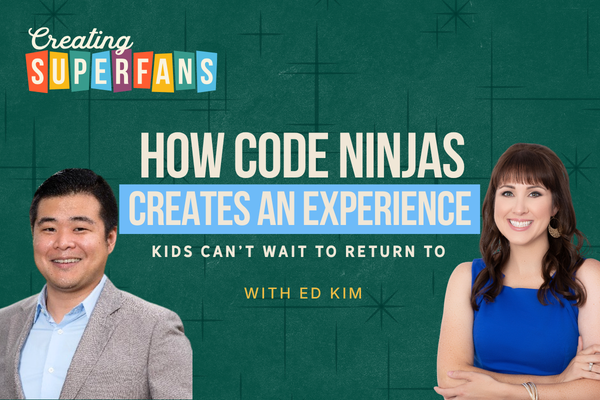
What does it take to create an experience that makes kids beg to come back—and turns parents into superfans?
In this episode of Creating Superfans, I sit down with Ed Kim, Vice President of Education & Training at Code Ninjas, a brand my family knows well. As a self-proclaimed Code Ninjas superfan, I ask Ed how the company has built an experience that inspires such passionate loyalty from kids and parents alike. Together, we discuss the challenges of delivering a consistent experience across a global franchise network, the role curiosity plays in learning, and how Code Ninjas is preparing students to thrive in a rapidly changing technological world.
You’ll learn:
- Why experience design is just as important in education as it is in business
- How Code Ninjas creates a space where kids feel ownership, independence, and belonging
- The role curiosity plays in developing lifelong learners
- Why adaptability may be the most important skill kids need for the future
- How parents can think about AI, technology, and online safety without fear
- What today’s kids can teach us about customer experience and innovation
- How Code Ninjas inspires students to become creators, not just consumers, of technology
- Ed’s vision for the future and the impact he hopes today’s students will have on the world
Learn more about Code Ninjas here.
Listen to the Episode
Listen on Apple Podcasts
Listen on Spotify
Watch on YouTube
Transcription
[00:00:00]
Kids are some of the world’s toughest critics. So what does it take to turn them into superfans? Not of a sports team or a movie franchise, but of learning. Because let’s be honest, most parents have experienced the battle of trying to get a child excited about education. But every now and then, a brand comes along that makes kids genuinely want to learn more.
And the lessons apply to every brand, not just those whose customers still have allowances. My guest today is Ed Kim, the Vice President of Education and Training at Code Ninjas, a company that’s teaching kids coding, problem solving, and critical thinking skills through an experience they actually love.
And as someone whose own kids have spent plenty of time in Code Ninjas classes and camps, I can tell you firsthand, they have created something special. In this conversation, Ed and I are talking about how Code Ninjas delivers a consistent experience across a global franchise network, why curiosity is one of the most important skills we can [00:01:00] cultivate, and how Code Ninjas is preparing the next generation to succeed in a world that is constantly being transformed by technology.
I’m Brittany Hodak. My guest today is Ed Kim, and this is the Creating Superfans Podcast. Let’s go.
Brittany Hodak: Ed, thank you so much for joining me on the show today
Ed Kim: Uh, thank you for having me. It’s a pleasure to be here
Brittany Hodak: Well, as you know, I am a Code Ninjas mom, and I’m so excited to have this conversation with you because I’ve really fallen in love with your brand and particularly our local dojo over the past few years as my son has become a superfan. And I wanna talk about the experience design that goes into the dojos. You really build them to be immersive and fun, and I, I wanna talk a little bit about why that experience design is so important in education, especially for younger kiddos.
Ed Kim: Great, great, um, question. So I think when you think about experience design, it’s us better fitting, and, and anyone who does this, better fitting the way kids need to learn, [00:02:00] right? Um, gone are the days where, you know, you could sit there and do 100 multiplication problems to memorize your multiplication tables.
You know, ever since Common Core education came out in the US years ago and things started to change and more technology came out, we have to think of classrooms not as a separate entity than the kid’s bedroom. That’s the way I think about it, right? So in a kid’s bedroom, you have like a, a s- one of the walls has their bed, and one of the walls has their desk, and so- one of the walls has their toys or whatever it might be.
You have a different organization to the bedroom than you have in the classroom. But mimicking that and making sure that kids feel comfortable learning in an environment that they feel comfortable reaching out and touching and doing things with, that’s kind of the core of what drives that experience design for us and, and for other services too, right?
Um, so building kids a comfort level saying, “Hey, this is just a bigger bedroom for me, so I can explore. I can just go get that kit. I can go draw on the whiteboard, or I can pop open my computer and, you know, do something,” that, that [00:03:00] kind of drives, um, how we see it, so.
Brittany Hodak: I don’t know if this is true of all the dojos, but there’s a line on the floor at ours that’s the no parents beyond this point
Ed Kim: Yes. That’s, that, that’s
Brittany Hodak: son
Ed Kim: that all.
Brittany Hodak: seriously. Like, there have been times where I’ve dropped him off and he’s forgotten his water bottle or something, and I’ve run back in and he’s said, “Stop.
You can’t come
Ed Kim: That, that’s a big part of it.
Brittany Hodak: line.”
Ed Kim: center, every center has that. And even, even if they don’t have like a big tape on the floor, they, they have the door. And there are kids I’ve seen sometimes they’ll run up, and if they see their parents about to come, they’ll close the door and say, “You’re not allowed back here.
This is our space.” Um, a- and so that’s, that’s the, you know, really funny but encouraging, you
know,
Brittany Hodak: and it’s so
Ed Kim: side of it
Brittany Hodak: you know, you hear, you hear people talk about, you know, the need for a third place and why Starbucks and so many other businesses that followed were successful because that’s what they were creating, and that’s really what you’ve curated for kids is,
Ed Kim: Yeah, yeah. 100%.
Brittany Hodak: know, it mimics their bedroom, and there’s some components of maybe a school environment, but it’s not either of those.
It’s a place that they can go and be and have just for themselves.
Ed Kim: Yeah, yeah. And, and sometimes we, we say [00:04:00] this phrase, it’s like, “Hey, it’s a safe space for you to nerd out.” Like, you can kind of bring whatever. Like, even if we don’t have a program for that hobby, you could come talk about it and share it. Um, you know, it, it is your space. Uh, but I think even us calling it the dojo kind of, uh, you know, kinda helps the kids detach it from being a, a, a place where I’m learning code or learning how to do things like, you know, at school.
So, uh, that’s another part of the experience design. Yeah.
Brittany Hodak: all of your, all of your instructor, instructors are senseis. I know my son
Ed Kim: right. Detaching it
Brittany Hodak: said like Mister before. He said, “No, it’s sensei.”
Ed Kim: Correct. Correct
Brittany Hodak: So of the, one of the really special things about franchises is being able to create the structure and the guidance and the guardrails of what the brand is, but then also allowing every local franchisee to infuse some of the things that make their city or their center special.
How do you kind of balance that so that you’re making sure that there’s that consistency in the brand, but there’s also the magic and the personality and the [00:05:00] community-led growth that comes from every individual franchisee?
Ed Kim: That’s a great question. Um, I’m gonna use food as an example ’cause it’s the easiest franchising to think of, right? Like in food, you can’t have variability in your consistency, right? It’s gotta be the same quality. People could get sick. I mean, and then people expect the same exact experience. I think the beauty and the flexibility of an education franchise is your brand is the curriculum you’re, you’re delivering and the manner in which you’re delivering it, whether it’s the platforms, the tools, the people.
But that gives a lot of room for your own application. So for example, um, one of the rules I say is, “Hey, if you’re gonna use, um, any of our materials, make sure our Code Ninjas branding is there,” right? Don’t, don’t modify it and change it so it’s all kinds of weird, like, you know, PowerPoint stars and all that of your own design.
Follow our brand. But it doesn’t matter to us if a franchisee will take maybe half of that content and use it with a student, because that’s where a student-centric mindset comes into play. [00:06:00] We’re building content that should be applied consistently, but if a franchisee or, uh, you know, a sensei decides, “Hey, this student would benefit better from taking a portion of this,” or me modifying this a little bit, that’s still okay.
So it, it– that’s, that’s kind of where the balance comes in. We, we set basic rules, but we don’t– we’re not rigid about everything that a student has to do, ’cause every student’s different, so we gotta give that flexibility in the learning path.
Brittany Hodak: Now, beyond that flexibility, what are some of the differences that you’ve engineered? Because, you know, I feel like there’s more choices than there has ever been for every parent when it comes to extracurriculars, after school, summertime. I mean, I was like, my, my kids’ schedules for the summer is something new and fun and amazing every single week. And my younger son was just asking me, “What are all the summer camps you went to when you were a kid?” And I was like, “Uh, we stayed at home. We played with our cousins, we rode our bike, and then like one week every summer there was church camp.” The
Ed Kim: Yeah.
Brittany Hodak: end of list. Um, so with so many options [00:07:00] for kids and parents, what are some of the things that you found really helpful in differentiating Code Ninjas as an experience?
Ed Kim: There’s one core message that we think about, and that’s tech readiness.
Brittany Hodak: Mm-hmm.
Ed Kim: And that’s what drives a lot of our marketing and, and a lot of our engagement with parents saying one of those areas where things are just ballooning and just it’s, it’s adding extracurriculars. It’s not just swim, sports, you know, arts, other, you know, type of classes.
It’s now drone flying camp and VR camp, and it’s like tech’s ballooning by itself. Uh, and so it kind of just kind of positions itself, “Hey, we’re the one-stop shop. We, we’re, we’re building programs around all these tech things.” But the idea is let’s build curiosity for your kids. So however you’re building your schedule, you know, for your– I’m sure you’re more of a chauffeur than you are, you know, actually actively participating in your kids’ activities, right?
So, um, it’s– You can select as many as you think your kids can handle, your schedule can handle, but align it towards what’s gonna make [00:08:00] your child or children want to learn on their own more. I, I think an interesting thing I think about with after-school education or any kind of education is that you shouldn’t need the service forever ’cause if the service is doing the right job, after a few years, after five, six, seven, whatever lo- whatever the subject is, the student’s walking away saying, “No, I, I have curiosity and I have the skills to explore this on my own.”
Um, so, uh, I think I’m starting to go off on a tangent now, but that, that kind of, you know, it’s all related in that sense.
Brittany Hodak: No, but I, that’s such a great tangent. I, I love the idea of that. I would love for you to kind of talk about as a brand, when you have that sort of engineered, we, we do it for a little while, and then the kids move on or they
Ed Kim: Yeah.
Brittany Hodak: I
Ed Kim: Yeah
Brittany Hodak: for you to talk about both from a referral standpoint of how you have not just, you know, the, the, the younger siblings or the younger people in that community, but you’ve got that sort of word of mouth, and then also the engagement you continue to see.
I would imagine some of your, some of your franchises have probably been around long enough now to where kids that went through the program are back as senseis, or they’re [00:09:00] back helping as, as a part-time job. So I’d love for you to talk about that pipeline a little bit.
Ed Kim: Yeah, that piping’s interesting. Um, it’s interesting that we don’t actually have a consistent referral program. That’s one of the flexibility left to the franchisee because, um, I think, I think we’re very relaxed in that th- sense where, hey, if we’re doing our job right, we don’t need to force a referral.
The parents are gonna say, “Hey, my kid went to this camp, loved it,” you know, “They’re friends, our kids are friends, let’s go together.” So the referral, that word-of-mouth piece is… I’ve been in other education business before, and especially for coding, just it’s interestingly very organic and very high, right?
Um, and sometimes I’ll just say it works better than our built-in lead generation tools and all that, right? Just because if one location ran a great camp for 20 kids, a school might find out about it and say, “Hey, do you guys offer that camp at our school?” And so the natural curiosity, um, that, that’s the one thing we thank COVID for.
COVID kinda did a weird hard reset on the resources for computer science and STEM education in schools. [00:10:00] Uh, budget cuts, things like that, right? A lot of, a lot of things went out. Um, and so schools, communities, they had this, this, uh, need for more STEM programs, for more computer science education. So, you know, that word of mouth really helps.
Um, I s- I’m sorry, I forgot the second part of your question.
Brittany Hodak: I, it was d- the, the pipeline of you said
Ed Kim: Yeah, the sense is, yeah, the kids coming back.
Brittany Hodak: they move on, and I was curious about that sort of coming back part
Ed Kim: It’s two ways. Yeah, they come back as teachers. A lot of our, you know, as long as the, you know, we meet the state minimum age requirements, uh, the kids can come back to work at 15, 16, right? And a lot of our summer camp teachers are those younger, you know, stu- uh, students and teachers who say, “Yeah, I finished your program.
I loved it. I wanna come back and teach.” And, and they’re, they’re so easy to train ’cause they’re like, “I’m gonna give the same experience I just had.” And so it’s a really natural self-fulfilling prophecy there. Um, another interesting thing that we’ve been seeing is our first ever students are now old enough to be in college and starting to be past college, [00:11:00] right?
Since the first franchise units opened. Uh, and these students have gone off to work for like Unity, the game company, or, or they’re studying game design, right? So it’s not like we have a direct line to that yet that we’re seeing, but we’re starting to, you know, track down these older students and say, “Hey, what are you doing in life?”
You know, “Did, did we help you? Did, did– Are you still pursuing tech in some way?” So, um, I think in Markham, Canada, we’ve– we heard of one great example where, uh, one of our centers has turned into a Unity certification center, where our, our students who graduate our program at black belt, uh, they do a little bit more studying, but then they take the level one programmer certification for the Unity company that they give to their employees, and they pass that test.
So they’re certified as a programmer at that point. So that’s really cool to hear. Um, so yeah, that, that’s the beauty of education. That’s the beauty of education in businesses. You see these really rich rewards coming out of student accomplishment and then coming back to work for you or, or things they create.
So, uh, that’s fantastic for that, you know, that side of the [00:12:00] business as well.
Brittany Hodak: Yeah, that’s very cool. My, my son is only a second grader, but Code Ninjas was sponsoring something at his school a couple months ago, and we didn’t know it till we got there and he saw the banner, and he immediately sprinted to the room in the school where Sensei Jeff was, and he said, “Can I hang out in here and talk about Code Ninjas?”
Ed Kim: That’s awesome.
Brittany Hodak: Jeff was like, “Absolutely, you can.” And there were probably, I don’t know, 25 different competing things and classrooms of activities, and I’m trying to get– I’m like, “Come see this cool art thing. Come do this.” And he’s like, “Mom, I’m working. Like, I’m talking about Code Ninjas.” And it was so cute and so
Ed Kim: Summer job coming up
Brittany Hodak: Yes. one of the things I would love for you to talk about is I feel like there’s a lot of and intimidation and uncertainty that parents have when they think about tech and AI with their kids. Just a lot of, you know, “I don’t know what the guardrails are, and this isn’t something I grew up in, and I, and I wanna make sure I’m preparing my kids, but I
Ed Kim: Yeah
Brittany Hodak: overexpose my kids, and I wanna give them all the tools.”
And you know, there, there’s so much I, I think [00:13:00] fear is probably not too strong a word around it. I’m curious, do you find that kids approach it differently? Do they think differently about AI and technology than many of the adult, adults that you encounter?
Ed Kim: 100%, I think. A- and I see this, uh, almost live, like, you know, you know, when I go to centers, um, you know, local center here in Georgia, in Alpharetta, you’ll see in the kids there. Uh, I’m gonna plug our AI academy a little bit to just, you know, kinda get some code ninjas in there. But, uh, we designed our AI academy program with this in mind because Gen Z and A are rejecting AI in a m- in the most surprising way.
I, I, I hear college students, uh, ’cause I’m still part of, like, other K through 12 education stuff from past roles, so I hear older students saying, “I actually feel the not learning part with AI.” And, like, it’s so apparent that I notice it, so me as a student, I don’t wanna use AI. So I think different generations are seeing it in different ways.
We as adults are [00:14:00] trying to accelerate our understanding of it as more than a tool, and that’s, like, kind of the fear and like, oh my gosh, this thing is so fast and scary because it can be an assistant, it can be an automated worker, all kinds of stuff, right?
Um, for kids though, I think they’re putting it at a tools length.
It’s like, this is just, like, for my parents and Google, but this is just something for me to use if I need it. Um, there are some kids who are leaning 100% into it though, ’cause they, uh, they’re… And I think it’s more of a how sci-fi is the kid. If this kid is very, very, very sci-fi, AI is like the coming of “Star Trek,” you know, “Star Wars” and e- you know, every, you know, sci-fi future they dreamed of.
Uh, but for the common, you know, everyday person who’s not as much of a sci-fi fan, I think, yeah, that’s– fear’s a great word for it. Um, I think parents should think of it as, is my child ready to adapt to whatever happens? It’s the adaptability. For– I think for you and me, and like for older generations today, it was do we have the hard skills to repeat, [00:15:00] rinse and repeat to survive in the system?
But for the kids, the system changes almost every week, right? So how adaptable is my, how nimble is my kid on their feet? If they get something new, are they gonna freak out about it or are they gonna say, “Oh, let me deal with my emotions real quick,” and then tackle the logical, intellectual part of it, right?
So that, that kind of thinking is what drove our AI academy content too. We’re thinking, we don’t wanna teach our kids, like, be AI engineers or masters. We don’t want them doing this, you know, while, while the parents are like, “What’s my kid doing?” And they’re plugged in for 20 hours, you know, on a computer.
It’s, “Oh, my, my kid knows how to use AI,” and they use it for drawing, but they only use it for writing, you know, ’cause they’re a great writer, right? They know when and how to use it, and that-that’s the right intent, I think, currently. We’ll see where AI goes in the next year.
Brittany Hodak: Well, I would say I totally agree with that, and the other thing that I think is really interesting with my two Gen Alpha kids is high their level of expectation is for AI, and when things go wrong, how frustrated they get. Um, my youngest son was [00:16:00] four years old when he fired Alexa. He was like, “You’re useless.
I don’t want you anymore.” Like, he was like, “Why don’t we have
Ed Kim: You fired all
Brittany Hodak: in our rooms? Alexa
Ed Kim: yeah,
Brittany Hodak: is terrible. She can’t do anything.” Uh, and you know, and he wasn’t wrong. Um, but watching how quickly my kids make choices in dynamic situations of when they wanna use AI, when they use voice search, when they type.
Like, it’s just really interesting to me to see how Gen Alpha kids expect everything to work, and can very quickly make a determination of what’s the fastest, most effective, most
Ed Kim: Yeah
Brittany Hodak: to solve this. Because I think you’re right, they look at it as a tool, and they get frustrated when that tool doesn’t work the way they believe it should’ve been designed to work for them. And the thing that I think is really cool, and I’m curious your thoughts as, as somebody who’s in the education space, my kids don’t know a reality where they can’t imagine something happening, and
Ed Kim: Hmm.
Brittany Hodak: feeling like they can [00:17:00] build it. Like, one of the, one of the things that my younger kid loves, um, it’s this brand called Snap Circuits, and it’s, it’s
Ed Kim: Yes. Yeah, yeah
Brittany Hodak: he loves that, and he’ll be like, “Well, I’m gonna build this,” or, “I’m gonna do that.” And I just imagine the adults that are gonna exist in, you know, 10, 15, 20 years because of the fact that when they were in elementary school, they could ask AI to create any video they wanted to see, to create any drawing, to take anything they do and animate it and bring it to life.
And that’s what I think is so cool about the skills that my son comes home with every time he does a Code Ninjas camp is he
Ed Kim: yeah
Brittany Hodak: really into stop-motion photography and animation because he did the stop-motion camp last summer, and now it’s one of his favorite things. And he creates these, like, cool little videos, and
Ed Kim: yeah,
yeah, yeah.
Brittany Hodak: to a how to be a YouTuber camp, and now he’s got his
Ed Kim: That’s
Brittany Hodak: channel that
Ed Kim: awesome.
Brittany Hodak: trying to plug and talk about.
And it’s so cool because I feel like you use curiosity as a tool to teach them the skills that I can tell as a parent are so transferable beyond just, [00:18:00] like, that thing that they think they’re learning.
Ed Kim: 100%. I mean, that’s absolutely right. Um, traditionally schooling has been subject-based. Chemistry, biology. We’re even thinking about this internally for us. Our next product line’s gonna be output-based. Like, if a kid wants to create a very specific thing, let’s pull in the pieces and tools they’ll need to get them there.
Let’s– It’s, you know, like, uh, you know, part of my background is studying engineering, so, like, you have to learn math, sciences, uh, you know, rigid bodies, all kinds of mechanics and all that just to get to that point. But is there a way to get a child to not have to go through all those courses necessarily, but get enough understanding to build the pieces they need?
So I think that’s the, that’s the beautiful side of AI or the beautiful side we could get to, assuming all the good players do everything right with it. Um, that’s what AI’s gonna free us up to do, I think, where there’s a lot of unanswered questions from kids to [00:19:00] adults. From a kid taking a Snap Circuit, kid saying, “How come this can’t do this?”
Oh, it doesn’t have the pieces. It doesn’t have the circuitry built. It doesn’t have something, right? Exploring that is still something humans are still gonna use AI to figure out, right? ‘Cause AI only knows what humans have trained it. So if we have unanswered questions, until it can fully infer and, you know, draw those conclusions, I think that’s the beauty that we’re gonna see in education, is teaching kids, hey, what tools?
Is it an AI tool? Is it a hand tool? Is it, is it your parents’, you know, brains? Whatever. You know, what are you using to get to your desired outcome? And I think that could drastically change schooling, which is both scary and exciting to think about, right? So
Brittany Hodak: is. And I, I love the output base because, for instance, one of the, one of the Code Ninjas camps… It’s funny, I feel like I should say at this point, I have no- this is not a sponsored episode. I have no affiliation other than just loving Code Ninjas. Uh, and I, and I was, I was, I was so
Ed Kim: No, we appreciate your support [00:20:00] of it
Brittany Hodak: yeah, I’m, I’m just a superfan customer. Um, my son, there was, school was canceled for
Ed Kim: Mm-hmm.
Brittany Hodak: a week because of bad weather and, you know, the roads where we lived were fine after like a day, but it took the rest of the week for the, for the rest of the county to be such that that school could be back in session. And so Sensei Jeff threw up a camp for, for all the kiddos to go to for the, you know, couple of days that school was canceled. And my son, of course, like anytime he, he knows there’s a camp, he wants to go. And it was like design and publish your own Roblox game. And he created a game in that first day that then all of his peers in class and his friends from school who are on Roblox could play.
And then the next couple of days he was adding new things and he’s like, “Now here’s
Ed Kim: yeah
Brittany Hodak: skin packs, and here’s my this and here’s my that.” And he was so excited to come home and show us that it was, I don’t even know the terminology, like the Roblox store I guess, like whatever the, where you can see the games. And his friends were starting to rate it. And he was so [00:21:00] excited that he had built, he had, he had come up with this game. He had imagined what he wanted to do. He published it and it was a simple game, but it was, it was really fun and it was exactly what he wanted it to be. And seeing how proud he was of that, and also in doing that, he did like 30 things I didn’t even know were like know, like the, the- then he’s like showing me the choices that he made. So with Roblox specifically, that’s one that I know I’ve had a lot of conversations with our
Ed Kim: yeah
Brittany Hodak: Jeff, because again, as a parent, you hear all the bad, you hear all of the things, and it’s confusing sometimes as a parent to know, okay, what should the guardrails be? And you
Ed Kim: Mm-hmm.
Brittany Hodak: I’ve got everything locked down, but then you, you know, hear some horror story or whatever.
How do you kind of approach those conversations as somebody who’s in this space to balance that we wanna give all the tools that the kids need to, to have that output to be successful, but we have to ensure that they’re safe and as you said, sort of depending on hopefully all the players do the right things and, and make the right but also it feels like we can’t always depend on [00:22:00] that.
Ed Kim: Yeah. There, I’d say I tackle this in three different levels, and it depends on how the, how strongly the child feels about that particular game. So we’ll use Roblox, as you mentioned, as an example. My first thought is to try to shift the student’s attention to a different game, ’cause the idea of creation, of, of building your own custom server and doing your own custom activities, your custom characters, all that stuff, that lives in a lot of other games.
So if, you know, that could be driven by his friends are all on Roblox, or maybe he could be the leader saying, “Hey, let’s try this new game out.” But I try to first shift that game. “Hey, have you checked out the Minecraft, you know, level stuff?” Or, um, “On this game, have you tried the creative studio abilities?”
Right? If that doesn’t work, then the second thing I think about is, uh, there’s the obvious like Surf Watch or whatever parental control you like. Veon is a great one you can put on your kid’s computer. But I think the most important guardrail is first making sure your child [00:23:00] understands like the bare bones of what being safe online is.
It’s like, “Hey, only talk to your friends. No random people. If it’s a random person, I need to talk to them first.” Like, you know, you put some kind of rules. Um, but ultimately, I think that’s the benefit of like yourself sending your kids to like these programs ’cause they’re gonna learn, “Oh, I don’t have to join a public server that everyone’s joining.
I can go create my own. I can go do this on my own.” And that’s where some of the risks are, in those public servers where, you know, there are unsafe people just waiting to, you know, check chat. Um, one rule I tell, you know, kids I talk to is, “Just don’t chat, guys. You should, you should be in a voice server with your friends,” right?
“Don’t, don’t, don’t text chat in, in any game server.” Like that’s a blanket rule I have in any game, right? Um, don’t let people know you’re online, you know, that kind of stuff. So it’s, it’s a balance of that. Like what are some home rules? What are some, you know, online behavior rules? Uh, if you wanna put software on, you can without your child knowing.
I think that’s okay, um, unless they’re gonna [00:24:00] freak out once they find out. Um, but I think most importantly, it’s give them the opportunity to learn, hey, you control your world online more than you think, and so you can build and, you know, do your own custom server. Um, that’s a fun thing. Encourage your friends to build their own server out, um, and build their own custom world out.
Um, if they invite people and they become the admins, that’s a more powerful expression of what they wanna do than just being participants. So
Brittany Hodak: I love it. Yeah, I, weeks ago, my son came home and was like: “Look, if you, if I get Roblox Premium, my own server is included every month.” Like, he was, he was trying to sell us. And I was like: “Okay, wait, so your pitch is that for,” whatever it is, like “$12.99 a month, we can get that thing that was 99 cents a month.”
Like, okay, I
Ed Kim: Yeah.
Brittany Hodak: I see how the marketing is working here.
Ed Kim: Yeah
Brittany Hodak: so in general, children are obviously so honest. Uh, they are never shy about
Ed Kim: Yeah
Brittany Hodak: opinions. What some of the things that you’ve learned from children [00:25:00] or that kids have taught you about customer experience as you’ve been in this role?
Ed Kim: Ah.
This is a joke, but, you know, I think our spy capability is severely underserved ’cause kids, they, they can see, observe, notice everything faster, and they say it like it is. There’s no filter. They’re like organized chaos agents,
Brittany Hodak: Yes.
Ed Kim: like perfect organized chaos agents. But I don’t know. I think what, you know, on a real note, one of the more surprising things I learned about children is that they’ve become more and more…
Or, uh, I think of it this way. As much as a screen gap, the distance to screens has closed more and more and more with generations, so has their, that distance to whether something works or not,
Brittany Hodak: Hmm.
Ed Kim: right? Um, I think we are in interesting times because I think between Millennials to Gen Z and then now to Gen A, we have a transition of where people fit the system, and now Gen A and Gen Z are kinda trying to make the system fit them, [00:26:00] right?
It, it’s no longer, you know, like the– I’m gonna sound so old here, but I’m not that old. You know like the days where you would have to open up the man- like those little printed manuals, like the, you know, Casio at RadioShack or something to try to figure something out,
Brittany Hodak: Yeah
Ed Kim: read the fine print. Um, and it was us trying to meet the system where things were.
But Gen Z, like to your, your point, your kid, if something doesn’t work, they’re like, “How come… Alexa, you’re fired.” Like it’s, it’s no longer, “Oh, let me figure out why Alexa’s not working.” It’s, “No, Alexa, you’re not working. Get out of my life,” kind of. That, that feedback loop is so much shorter with children, and I think it’s refreshing to me.
Um, ’cause I, I’m, I work that, that way too. I like direct A to B to C kind of, you know, let’s figure things out. And so when kids give such direct feedback, um, what they like to engage with and don’t like to engage with is very clear. Um, I think a second thing is, I think it’s our faults
Brittany Hodak: Okay. I
Ed Kim: How they, how, [00:27:00] how they, how they en-en-engage with new things. There seems to be more of a, not a fear, an apprehension with children to say hi to people that their parents are engaging with or things like… I, I don’t know. I, I can’t really form this into words as well. It’s been something I’ve been noticing where kids have a different approach nowadays to new things than, than we did, right?
Um, and so I don’t know which side of the fence I stand on with that just yet. It’s, it’s interesting to see. Um, but yeah, it’s refreshing how direct they are. That, that’s one of the main things. Uh, they say, “This works for me, it doesn’t work, and I’m refused to engage with it or I will engage with it.” So it’s very black and white in a lot of cases.
So
Brittany Hodak: I love that. The other thing that I’ve noticed just in the past several months with both of my kids how skeptical AI made them.
Ed Kim: That’s a good word for it.
Brittany Hodak: they’ll, they’ll see a
Ed Kim: yeah
Brittany Hodak: or they’ll see something and they’ll say, “That’s AI.” And, and I’ll either say like, “Okay, well let’s [00:28:00] investigate or figure out,” but even there, there was like a, like a puppy video that one of my friends sent me the other day that
Ed Kim: Mm-hmm.
Brittany Hodak: was, I was showing, I was showing my youngest son and he was like, “That’s definitely AI.”
And I was like, “No, it’s not AI, but like, let’s, let’s talk about some of the things that would’ve been a giveaway, like how would we have known for sure if it’s AI?”
Ed Kim: Right
Brittany Hodak: feel like again, sort of living in this world where now everything is possible and you can just like speak a command and get whatever output you want seemingly, um, it’s gonna be really interesting to see how the demands of those children as they have more economic power in the marketplace change things
Ed Kim: Yeah. Yeah. I think something interesting to track with that too is I read this article the other day with, uh, how the real parallel to follow with AI is the rise of the computer from like back in the ’70s, ’80s. And you know, that there– it, AI’s going through the same thing digital devices first went through then, and there was like this huge uphill battle it had to climb, and then it became just it’s an everyday thing.
Uh, so to your point, I, I could imagine a future where Gen A has grown up and [00:29:00] a- as adults, AI truly is like, like a little, a little hologram pet that, you know, follows them around in midair just like, you know, doing things that they request. It’s like, uh, I guess Iron Man. They have their own personal Jarvis, you know, running around, right?
Um, so it is curious to see how that develops. But yeah, skeptical is a great word to use for the skepticism or yeah, not– hopefully not cynicism. Not yet. It’s just skepticism.
Brittany Hodak: Yeah, no, I think not yet with, with my kids, but obviously they are younger. And, you know, one of the, the sort of AI wearables and, and, and Jarvis future, the thing that I find so promising about that, um, so, you know, I have, I have Meta Ray-Bans and all of the sort of like, you know, ethical concerns aside, um, the thing that I enjoy most about them, other than the fact that the, like, the audio quality is incredible, um, is that I don’t have to have a device in my hands.
And to be able to t-take a picture without having to take, get a phone out of my pocket, or when one of the kids ask me, you know, “What kind of tree is that?” Or, or, “What’s this?” Or whatever, [00:30:00] just to be able to, like, stay in that conversation, in that moment with them, but have
Ed Kim: Yeah
Brittany Hodak: AI give me the information that I don’t have, it really is, y-you know, to use a very technical term, like the robotification of, of humans.
Like, it is, it’s very, it’s, it’s very cool, and obviously we’re still very early days, but I think that parallel with, with PCs is, is exactly spot on. Yeah.
Ed Kim: yeah
Brittany Hodak: none of us really quite know. I think that we can, you know, look at so many different options of, of where it might go and, and different futures that we can see, and we’ll, we’ll see who wins on the hardware side.
But, um, I think it’s very exciting for me to think about all of the new possibilities reimagining what connectivity looks like.
Ed Kim: Yeah. A-and I think– And so, so I am a sci-fi geek, right? I grew up on this kind of stuff. So, I mean, I think there is some sci-fi book or creative art or thing that outlines some possible future, right? But I think if I can imagine, like, the next technology [00:31:00] that will really help accelerate that kind of future, it’s light projection, holographic technology.
One-once I think that comes out, like, you do get, like, even way back when my– when Minority Report with Tom Cruise showed, like, that holographic screen that they were using, but it was still a glass screen, that kind of exists today, right? So I almost see that next evolution to your point. We have our, you know, we’re, we’re robotified in some way.
Brittany Hodak: Yeah. Smart contacts, I mean, that’s a really exciting field that’s, you
Ed Kim: yeah. That’s really cool. Yeah.
Brittany Hodak: implications of everything you can do with those
Ed Kim: think that’s gonna disrupt like any kind of glasses technology or that’s gonna create new glasses tech. But I mean, it’s cool to see where that goes. So I think,
Brittany Hodak: Yeah
Ed Kim: you know, as much as much doom and gloom there is in the news about AI and all that, I mean, there’s gonna be a negative side to it.
There is a huge potential to where it could take, I guess, the way we live our lives in a way. But I think our jobs as educators and parents though is we– I think humans will become more the guardrails rather [00:32:00] than written rule and like guidebooks and handbooks, right? We’ll become more and more the guardrails for Gen A and I guess Gen B, whatever they’re gonna call the next one, right?
So, yeah
Brittany Hodak: Um, so let’s, a, as a, as a sci-fi fan,
Ed Kim: Yeah
Brittany Hodak: sort of put yourself in, in the future.
Ed Kim: Okay
Brittany Hodak: do you hope 20 years from now to be able to look back and say,
Ed Kim: That’s a great question
Brittany Hodak: that a Code Ninja student did this or had this experience”? Or w- when you think about the legacy your company is creating with all of these children who are coming to you to, to learn, to grow, to prosper, not to sound kind of Star Treky, um, like what, what do you hope that the legacy is a couple of decades removed from right now?
Ed Kim: That’s a fantastic question. Wow. That’s another lot of great question. That’s a great question. Um, if I had to put it in one way, I hope that a single child comes out of Code Ninjas in 20 years [00:33:00] having created and solved for something that they couldn’t solve for with us, but they discovered it with us.
That would be my ideal kind of int- you know, intangible reward. It’s like 20 years from now, the, the tech bro of them, it’s like, “Yeah, you know, part of my experience when I was a kid, I was at this place called Code Ninjas. I was working on this. It– we couldn’t solve this because, you know, this didn’t exist, and that sparked my race to build this company,” or something like that, right?
Like igniting even one child to become a superstar innovator of the future, that would be my dream. So I, I’ve, I’ve experienced this once before, and I say it ’cause it- it’s something, uh, you know, I had in one of my previous roles. One of the first students I ever tutored, uh, became a surgeon a-
Brittany Hodak: Wow
Ed Kim: a very successful surgeon, right?
So me hearing that like 20 years after the fact, I was like, “Wow.” You know, when I caught up with him, he was like, “Yeah, I remember how hard you were with me as a tutor, you know, making sure I got good grades and all that. Uh, that kept me going through med school.” And I was like, “Wow.” Like [00:34:00] that’s wonderful to hear.
Like that makes everything worth it. So yeah, that’s the legacy I hope we have. Even one child, if not more. So
Brittany Hodak: I am so confident it will be many, many more than
Ed Kim: Thank you.
Brittany Hodak: child. But speaking of one child, uh, my son has a
Ed Kim: Yes. Yes
Brittany Hodak: wanted to ask you.
I’ll just read it to you. Uh, his question was, “What’s the coolest thing a Code Ninjas student has ever made out of Lego?”
Ed Kim: Ooh. That’s a great question.
Brittany Hodak: wanna use his name when you answer. But I know you guys do so much with the Lego robotics. He’s actually about to do his first Lego robotics thing this summer, um, because he… I don’t know if he wasn’t old enough last summer or he just wanted to do something different. For whatever reason, that’s like the one thing we haven’t done.
He’s done like one-day Lego things, but we haven’t done the like robotics camps yet, so
Ed Kim: Okay. Look at the coolest thing I am recalling this from now is early when I f- when I, when I first s- joined Code Ninjas, this student had taken over, I think, [00:35:00] multiple kits. Like, they, they needed multiple kits ’cause they, they were a huge Transformers fan. So I think in the second or third movie, there’s like this massive Trans- uh, like bad guy Transformer that comes, like that’s built from like five different Transformers or something.
And so he built versions of these Transformers, five of them in, in five different little robots, and then figured out a way to make them transform into one. But he used a lot of pieces and he had to space it. I mean, he was experimenting a lot, spacing it around ’cause it didn’t sound like they connected to each other like real Transformers, but they would like move and then reshape into the new structure.
So that was k- that was the coolest thing I’d seen.
Brittany Hodak: That is so cool. And how old was this kid?
Ed Kim: Uh, nine, 10-ish. Yeah, yeah. But that’s the curiosity thing, right? They’re like, “Oh, I saw– I love Transformers. I wanna do this. Let’s make it.” So yeah, that’s a cool… But I’ve seen a lot of other cool things. It’s not like that’s a huge gap. There’s… Kids come up with the craziest things to make with Lego.
Um, what about your son? What, what has he made?
Brittany Hodak: He has made all kinds of things with Legos, [00:36:00] uh, over the years,
It’s wild as a parent to watch your child, A, ask for, like, an expensive Lego set, and then open it up and be like, “Nah, I don’t wanna build. I’m just gonna take, you know, I’ve got the 20,000 little Lego pieces over here that are in bulk, but I don’t want any of those. I wanted to buy this specific set so that I could buy something completely different,” totally disregards the instructions. Uh, which is really fun, but just, you know, ironic that it’s like, “No, I wanted this specific set to build something completely on my own.”
Ed Kim: All right. That’s good. That’s good
Brittany Hodak: rebuild content, too, I feel like plays into that on, on YouTube. Like, they’ll, they’ll s- y- you know, it’s like the, one of the famous examples is, like, Millennium Falcon guy, who, like, will take any set and turn it into a Millennium Falcon.
Ed Kim: Yeah, I,
Brittany Hodak: got people who will do that with, like, they’ll, they’ll take a random set and turn it into a Pokemon or
Ed Kim: Wow. Yeah, yeah. It’s so innovative
Brittany Hodak: from some show, which is just, like, so fun and so creative.
Ed Kim: Yeah
Brittany Hodak: So Ed, before I let you go, one of the questions I love to ask every guest is, what’s something that you are a superfan of right now that more people need to know [00:37:00] about?
Ed Kim: Oh, that’s such a tough question ’cause I feel like
in the, in the internet age, everyone has seen everything.
Oh my goodness. No, you know, it’s, it, it’s two things I’ll say. One, one’s kind of, you know, pranky, I guess. I just recently discovered these Porsche, Porsche Pirate Revenge videos, which is these engineered boxes that, like, explode paint on it, and I thought, “Okay, that’s an interesting app.” It’s like a Mark Rober-type application of like, you know, you know, managing, I guess, your community.
Uh, but I think one thing I wanna encourage more, more of, I’m a superfan of hikes with waterfalls at the end, and I’m kind of flipping back. I’m, I’m kind of moving away from s- from social media tech and all that. I wanna go back out to nature. So I, you know, there’s beautiful hikes here in Georgia and, and at the end there’s these beautiful waterfalls, and just taking the time to go out and break away from the screen is, is my superfan thing.
Um, yeah. Online trends, I don’t know. Not a big fan of those.
Brittany Hodak: Other than
Ed Kim: What’s that?[00:38:00]
Brittany Hodak: porch pirate justice
Ed Kim: The Porsche Pirate. It just– I don’t know why it popped up on my YouTube feed. It’s just out of nowhere. It’s like history of this and then Porsche Pirates, and I was like, “Oh, let me click that.” And then just dragged me down
Brittany Hodak: But
Ed Kim: a rabbit hole
Brittany Hodak: that, the hike with the payoff of the waterfall at the end. Very cool
Ed Kim: yeah.
Go outside and spend like an hour outside i- in nature. I think that that’s what I’m a superfan of right now. So I’m a little boring that way.
Brittany Hodak: Ed, thank you again for coming on the podcast. Where can people learn more about you and Code Ninjas?
Ed Kim: Uh, come to codeninjas.com. You guys can, uh, check out my LinkedIn, um, my social media, very rare updates. Uh, I don’t even know my tags anymore, but yeah, you can find me online, um, and
Brittany Hodak: and put them in the show notes.
Ed Kim: yeah. Yep
Brittany Hodak: Awesome. Thanks, Ed. Talk to
Ed Kim: All right. Thanks a lot.
Paragraph