


Episode Summary
It’s hard to think of another person who belonged to so many people quite like Dolly Parton.
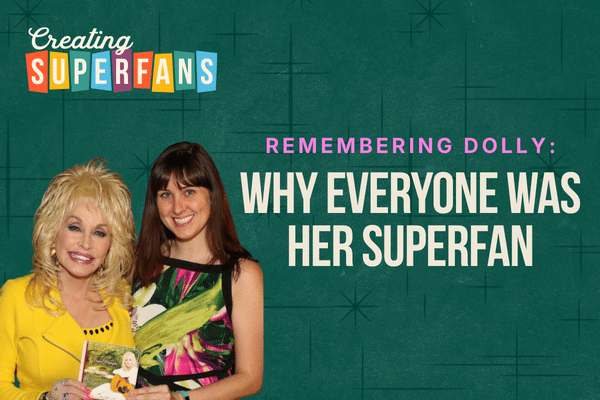
In this special episode of Creating Superfans, Brittany reflects on Dolly’s extraordinary life and legacy, sharing personal stories from the times she was lucky enough to work with her and exploring why generations of people felt such a deep, personal connection to her.
Using the SUPER Model from Creating Superfans as a lens, Brittany breaks down some of the qualities that made Dolly truly one of a kind: her unwavering authenticity, her remarkable empathy, her ability to make every person feel seen and special, her commitment to exceeding expectations, and the consistency with which she showed up for her fans and her craft.
Brittany also shares the story of meeting Dolly for the first time while working on the Pure & Simple album release, the thoughtful way Dolly approached her Imagination Library, and why Brittany’s own kids grew up knowing her simply as “Aunt Dolly.”
More than a celebration of an unparalleled career, this episode is a look at what happens when someone uses their platform to make other people feel like they matter. Dolly didn’t just build a fanbase—she created a sense of belonging that crossed generations, communities, and cultures.
It’s a tribute to an icon, a humanitarian, and a masterclass in what it means to leave people—and the world—better than you found them.
If you’re interested in Brittany’s leadership training video, “What Would Dolly Do?, make sure you’re subscribed to her newsletter.
Make a donation to the Imagination Library
Listen to the Episode
Listen on Apple Podcasts
Listen on Spotify
Watch on YouTube
Transcription
[00:00:00] It’s hard to believe that it’s been a week since we lost Dolly. Um, and I think part of the reason why it’s hard to believe is because for many people, not just in Tennessee where I live, but across the world, she kind of seemed immortal. And, you know, for people who don’t live in Tennessee, it’s– it just feels like she’s everywhere.
Her spirit is everywhere, not just, uh, where I live near Nashville, when it– where it’s all over, you know, things like the-the Opry and the Ryman, just all these institutions that we, um, think of, um, when we think of Nashville that are so intertwined with her and her legacy. But as you go east in Tennessee, as you get closer to-to Dollywood and Sevierville and Pigeon Forge and just everything she’s done for those communities.
And so, um, I thought what I wanted to do for this episode is to talk about Dolly, to talk a little bit about some of the times I was privileged to get to work with her, but also talk about [00:01:00] w-what is so beautiful about all of the tributes that we’ve seen in the past few days of everyone sharing either very personal stories about working with Dolly or meeting Dolly or being touched by Dolly in some way, to the people who didn’t ever meet Dolly but felt like they did, felt like they knew her, felt like she was part of the fabric of their family and their lives and, and who they are.
And, you know, as somebody who has spent the past couple of decades just obsessed about super fandom and why do we love the things that we love, why do we share the things that we share, I think there is so much to learn, not just from the incredible human that Dolly was, but what we’ve seen in the past week in the outpouring of love and support as people come together to mourn and share stories and just celebrate this incredible person.
Um, I was saying to a friend the other day that I, I really think that Dolly is gonna be one of the figures from the past hundred years, [00:02:00] not just in music, but all of pop culture, that is remembered for, like, centuries. You know, if you go back and you think about, you know, people talking about, like- I don’t know, Beethoven or, um, you know, just, like, historical figures and you think, you know, they had contemporaries.
They had other people who were doing stuff, but there’s the few names that stand out and the few that we remember. And even, you know, compared to, like, like The Beatles and Elvis, like, Dolly, of course, was so successful in the realm of music, but that was just one small part of it, and I think that’s part of why it has touched so many people the way that it has.
Like, I remember, you know, listening to my dad talk about, like, when John Lennon was killed or listening to my grandma talk about when Elvis died and how everybody just sort of, like, remembers where they were and, and what it was. I think probably one of the closest things that I, um, remember happening and honestly being, like, a little taken aback was when, um, Michael Jackson died.
And obviously, I knew he was [00:03:00] a huge star, but I was born in the early ’80s. Like, I was never a huge Michael Jackson fan and, like, his legacy to me was always sort of like, you know, yes, the great songs, but also, like, the scandal. And, um, so I was, like, a little surprised. Um, I remember one of the things– my husband’s older than me, and so he– it’s, it’s always interesting, like, when pop culture stuff happens.
Just the other day, he’s like, “You’ve never heard of something?” And I can’t even remember what it was. It was some movie that was, like, such a big deal to him, but I had never even heard of it. Um, and so stuff like that happens. And I remember, um- Michael Jackson died the same day Farrah Fawcett died. And in my head, if you had asked me beforehand, like I knew Michael Jackson was a bigger star, but I didn’t know it was like exponentially bigger.
Like if you had asked me, you know, Farrah Fawcett versus Michael Jackson, I would be like, “I don’t know.” ‘Cause they were kind of both like before my time. Um, it w- it was like names that I knew and references that I understand and, and things that I had seen, but like I didn’t live through it. And I think when you don’t live through [00:04:00] something, you always have a bit of a skewed perception, and sometimes it’s, you know, romanticized, like when I think about like the moon landing or something that happened before my time.
And other times it’s like we, we don’t just like quite understand. And the thing that I think is so evident right now with Dolly is how many generations of people felt like she was theirs. From my grandma, who is in her 80s, and I know she would tell you that like the old-timers like her, to use her language, were, were Dolly’s favorites, right?
Like the ones who had been watching her from the Porter Wagoner days, who have followed her career, who have supported her through every single stage of it, who remember her as that little teenage girl singing at the Opry. Because Dolly made those people feel like they mattered the most. But you know who she also made feel like they mattered the most?
The kids. The millions, hundreds of millions of kids that have gotten books through Imagination Library, or probably it’s like tens of millions of kids, but still so many kids. I think the most recent number I [00:05:00] saw was they’ve sent like 330 million books out. So like my boys, who both grew up getting books from Aunt Dolly in the mail every month, they felt like Dolly was theirs, not just when they got those books every month, but when they went to Dollywood.
And, you know, hearing the conversations that they had with their friends at school, um, when Dolly passed last week, because again, I know it’s probably a little different here in Tennessee where we lived than, than in other places. But millions and millions of kids across the country feel like Dolly was theirs because she was the book lady, um, the one who sent those books to them every single month.
So, um, I put together a training. It’s five leadership lessons that we can all learn from Dolly and really getting in the habit of asking yourself, “What would Dolly do?” And looking at some of the decisions that she made and the intentionality throughout her career. I recorded that on Friday last week.
It’s not edited yet. It’s not done as of the releasing [00:06:00] of this podcast. But when it is, I’ll add it to the show notes. And if anybody listening to this right now, um, wants it before it’s out, just go to my website and sign up for my newsletter. So you can go to brittanyhodak.com, sign up for the newsletter, and I’ll send this training out to everybody.
It’s probably gonna be like 20 minutes long, and it’s totally free. Um, but I wanted to do something a little bit different in this podcast today. As I said, I wanted to sort of look at who Dolly was and what she did through the lens of the supermodel. And the reason is because, you know- It’s sort of my operating system for how I look at things, how I look at life, that for anybody who’s not familiar with it, that’s the framework in my book Creating Superfans.
And one of the things that I say again and again and again in my book is that superfandom is a two-way street. If you want people to love you, whether it’s you as a personal brand, whether it’s your business, whether it’s some subset of what you’re doing, if you wanna go from being seen as simply a commodity provider to a category of one, you have to connect your story to your audience story.
So [00:07:00] whether that’s your customer story, your employee story, whoever that is on the other end, you’ve gotta make your thing relevant to their life, because apathy or indifference is the single biggest threat to every organization. And what is so incredibly evident is that there was no indifference. There was no apathy to Dolly.
Even people who were like, “You know, I don’t know that much about her. I only know a few of her big hit songs,” were like, “But she seemed like an incredible person. She did so much good for the world. She was such a great human.” So let’s look at Dolly through the lens of the SUPERMODEL. So up first is S, start with your story.
And you know, the thing that I love so much about Dolly is she is unapologetically who she is. I know I’m, like, probably still talking in present tense, um, for most of this episode, but it… I mean, it seems like it should be, right? Like, I feel like so many people are saying, like, you know, Dolly is immortal, and she’s always gonna be here.
So, um, forgive me for, like, going back and forth probably [00:08:00] between, between past and present tense. Um, but Dolly was so unapologetically who she was, and you’ve probably seen stories of her talking about how she got her image from what she would call, like, the town tramp or, or recall the story of her parents calling the, the lady a tramp or trash, and she was so unapologetic as who she wa- uh, for who she was.
And in, you know, many of the interview clips that people have been sharing on, on Instagram and other sites of her going back to, like, the ’70s talking to, like, Barbara Walters or Johnny Carson but even then more recently saying, like, “People think I’m a joke, but I’m in on the joke. Like, this is, this is what I’ve decided to, to do.
This is who I’ve decided to be.” And the bigger and the more famous she got, the more she leaned into that. Like, she didn’t become less Dolly as her fan base or her audience grew, and I think sometimes the hesitation, um, people have to go all in or, like, the temptation people feel is that as their audience grows, they’re like, “I’ve gotta [00:09:00] come more to the center.
I’ve gotta be more measured. I’ve gotta be a little less extreme.” And Dolly proved that the absolute polar opposite of that can work, which is to be unapologetically who you are, because she knew who she was. She knew how she wanted to let her light shine, and I think You know, that’s a great, that’s a great lesson for everybody.
It’s you’ve gotta know who you are. Um, I also have really enjoyed all the clips people have been sharing of Dolly talking about being ambitious and saying like, “I want more. I’m still dreaming. There’s still more I wanna do. There’s still more I’m dreaming about.” At any point, she could have, for like decades, said, “I’m done.
I’ve got plenty of money. I’m gonna put it in the bank and watch it grow,” but she kept going. And so she knew exactly who she was, and that she still had joy to bring and give, which is so incredibly special. The second pillar of the Supermodel Framework U is all about understanding their story, [00:10:00] so your customer story.
And, you know, Dolly was so beloved by every community, but the gay community really claimed her as their own. She, on every occasion, took the opportunity to stand up for people, saying, “You are who you are, and you love who you love.” And any time she got pushback, she would say, you know, and there’s a couple, uh, videos of her saying variations of, “I’m not Christian enough to judge other people.
Uh, the Bible tells me to love my neighbor as myself, so that’s what I’m gonna do, and I’m gonna leave the judgin’- the judging up to Jesus.” And I think a lot of times in the world, we are sold this lie by people who are trying to, you know, get our eyeballs or sell advertising, uh, or, you know, banner ads or whatever, um, that you have to, like, pick one extreme, right?
And what I loved about Dolly was she said there’s room enough for everybody, and everybody belongs. And she could quote the Bible [00:11:00] with the best of anybody, and she had no problem saying everyone matters and, and Jesus loves all his children the same. And so because of that, she was so beloved by so many and really made everyone feel seen.
And what I think is so cool about all of the tributes pouring in on social media are people saying, you know, “She saw me at a time that nobody else saw me,” or, “She understood me in a way that I felt like other people didn’t.” And you know, what a beautiful, incredible legacy. She was someone who was clearly so incredibly empathetic and, you know, she spoke on many occasions, including to me once for, for Forbes, about the founding of the Imagination Library and how, you know, she did it to honor her dad, who never got a chance to learn to read and write.
And that… seeing that and saying, you know… and she was always very quick to say what an incredible man her dad was, you know, a great father, um, a great farmer, a great leader, all of those things, and he just happened to not be able to read or write. And she [00:12:00] wanted to ensure that no other kid had that same, had that same fate.
And so that, that empathy, that understanding led to something that she, on many occasions, said she hopes is her ultimate legacy, the fact that these hundreds of millions of books about all kinds of things have gone out. Um, one of the, one of the really cool things that I’ve seen people share that I wasn’t aware of until her death is that, um, they send out braille versions of the books.
So any child who is blind or low-sighted that signs up for the Imagination Library is gonna get books in braille, which is a big deal because they aren’t always readily available or they’re very expensive to order specialty books online. So just things like that of saying, “I’m gonna make everyone included ’cause there’s enough love for everyone to go around.”
Uh, the P in my supermodel framework, S-U-P-E-R, stands for personalized, and it’s really about making everyone feel like they matter, like they’re special. I always say the superfans are [00:13:00] created at the intersection of your story and theirs, like I mentioned before, and that’s what personalizing is all about.
And in the leadership training I recorded, I shared the story of the first time I ever met Dolly in person. We had been working together on a deluxe edition for her Pure and Simple album that came out in, I think, 2016, and it was, it was, uh, such a great experience. We did this deluxe package for Cracker Barrel.
The album debuted at number one, not just in the United States, but across the world, and we had this really cool deluxe edition that we worked on together for Cracker Barrel, and I wrote all the liner notes for it. So it was, I don’t know, it was, like, 48 pages or 64 pages or something like that. Um, and I had interviewed Dolly and gone back and forth with her team and was, you know, so proud of this package and excited for the package because of how much Dolly has meant to me my whole life and my whole career, and what a cool opportunity it was to, to collaborate with her on this piece.
And so I’d flown to Nashville for the day that some promos were gonna get [00:14:00] recorded ahead of this album launch for Cracker Barrel. And I was living in New York at the time. I flew down and, uh, when, when Dolly’s manager introduced the two of us and said, “You know, this is Brittany. She’s is the CEO of ZinePak.
She’s the one who, who wrote the Pure and Simple release,” she gave me the biggest hug, and she immediately started talking about how much she loved the package, that she got so excited when she got the first advance that I had FedExed down, like, a couple days before, um, that she immediately said to her team she wanted some extra copies ’cause she wanted to give one to her sisters.
She wanted to give some, um, to her friends. She wanted to give one to her preacher, and just, she was going on and on about, um… I think she, she called me a beautiful and brilliant writer. And I… It was, like, so hard to keep it together in that moment because, you know, here is this, this icon, um, this, this, th- this incredible larger-than-life talent, and she’s turning that- amazing light that she emits around and, and shining it on, [00:15:00] on me, somebody who she was meeting for the very first time.
And it was so incredible and so memorable. Actually, I was, like, trying to keep it together through that conversation. Um, and my friend Travis, who is a part of our management team, uh, was there. And, and Dolly was like, “Oh, we’ll have to work on something else soon.” And we started talking about the Glastonbury record that she had coming out, like a live from Glastonbury, and they were like, “Yeah, you should just write the liner notes for it.”
And I think I babbled something back like, “I’ll write your shopping list if you want me to, Dolly. Like, I’ll do anything at all,” because I was, you know, so overwhelmed and so grateful, um, for her, for her love and for those kind words that she didn’t need to share, right? Like, she’s Dolly. And I have seen hundreds of tributes, both from dear friends, from people that I know casually from working with in the music industry, sharing very similar stories.
Saying, you know, Dolly made sure every single person on the crew got a photo with her, even the ones that were like, “That’s okay, we don’t wanna bother you,” because she knew what a big deal it was to everybody. She [00:16:00] understood that she was the biggest star in the world. And one of the things that she said to me when I was interviewing her about the Imagination Library for Forbes one time was how much more special she thought it was that kids got the books in the mail with their name on it, because when it had their name on it, it meant it was theirs, and they were gonna go find somebody who could read that book to them.
She said, “I know if it shows up in the mailbox and they can’t read it themselves yet ’cause they’re two and a half, they’re three, they’re four, whatever, they recognize their name, and they’re gonna go get somebody to read that book to them,” because she knew the power of it being theirs. And as a little girl who grew up, you know, with next to nothing in terms of material things and wanting things, she knew how important that was for those kids to get those books.
And, you know, I saw that firsthand, too. My boys, I remember, um, I, I shared the story on, on social media, um, last week when she passed that We always just said the books were for Aunt Dolly ’cause it was, like, [00:17:00] the easiest thing to do. It was like, “Oh, you got another book in the mail from Aunt Dolly. Oh, Aunt Dolly sent you a book.
Aunt Dolly sent you a book.” And I didn’t really, like, think anything about it at the time until one day my son, um, Kadoh, said, “Mom, is Dolly really my aunt?” And I was like, “Yeah. Yeah, she’s, she’s Aunt Dolly. Of course she is.” And he said, “Well, where does she live?” And I was like, “Oh, she lives over in Brentwood next to Mr.
Jim,” ’cause my, my attorney, Jim, who I love you if you’re listening, Jim, you’re the best, um, lives in Brentwood, like adjacent to Dolly’s property. And I was like, “You know Mr. Jim. Like, Dolly lives, um, next, next to Mr. Jim.” And he said, “Well, why don’t we ever go visit?” And I was like, “Uh, well, she hasn’t invited us over.
She’s on tour a lot. She’s gone.” And he said, “Well, why doesn’t she ever come visit us?” And anybody with kids, you know they just, like, once they start asking those questions, you’re like, “How deep am I into this, uh, to, to this first lie that then led to, like, 80 truths?” So finally he goes, “Okay, is she my Aunt Dolly on your half of the family or [00:18:00] Dad’s half of the family?”
‘Cause we’d been talking about, you know, how everybody’s related, like, a couple days before that. And then to the point where I was like, “Okay, I’m cooked. I think I need to, like, stop with this.” And so I said to Cato, “Dolly is everybody’s aunt. It’s true that she’s your aunt, and it’s true that she’s a lot of other people’s aunts, and it’s also true that she’s not family related to us, but she loves you as if she were your real aunt.
And Dolly is for everybody. Everybody has Aunt Dolly, just like everybody has Santa Claus. Like, Santa Claus is for everybody, Aunt Dolly is for everybody.” And that, um, seemed to, you know, appease him a little bit, long enough for him to, like, forget about it and just be excited to read the book. But from that point on, both my boys have always just said Aunt Dolly.
And, like, when we go to Dollywood or we go anywhere, and that’s so common here in Tennessee. Like, the … Again, for anybody who doesn’t live here, it… You may not recognize, like, how deep it is ingrained. Um, I, as somebody who flies all the [00:19:00] time, I was so excited, um, to hear that they are gonna go ahead and rename the airport.
I got in on the, um, petition, like, a year and a half ago or whenever they first circulated it. I was like, “Yes, that’s incredible.” Like, I can’t think of a single airport named after a woman. Um, and it’s funny, like, uh, the Little Rock Airport is named after Bill and Hillary Clinton, but I was like, “I can’t think of another, like, major airport.”
And then when they announced that they were renaming it, um, that’s true. There’s not an international airport. There’s a couple smaller airfields and some terminals. Um, but the, the Dolly Parton International Airport will be the first international airport in the United States named after a woman, which is so incredibly fitting and such a wonderful tribute for someone who gave so much to this state and to the world. So the fourth pillar of the supermodel, E, is exceed expectations. And I mean, we don’t have to say that much about this because it’s so clear that that was a core part of who Dolly was. She wasn’t only the smartest and most [00:20:00] creative and most intentional and most talented person in nearly every room she was ever a part of, but she was the most prepared.
She didn’t wait for it to become evident that a moment was incredibly important before treating it like it was. She was always about raising the bar for herself and for everyone around her. Um, one of my favorite fun examples of her just, like, being so over the top, uh, is the Dallas Cowboys Cheerleaders performance from, I think it was 2023, when she was with the Cowboys Cheerleaders on the field during the Thanksgiving Day game, and it was just incredible.
And everyone in America was like, “This is so fun. This is so great.” You know, she didn’t have to wear the Cowboys Cheerleaders outfit, but she did, and everybody loved it, and the performance was just so absolutely incredible because, again, she never showed up halfway. Um, there have been so many stories circulated about how she, um, you know, would sleep in her makeup and always have the wig on and things like that.
And, um, it remind me-ded me of [00:21:00] when I was a mascot. And, um, when I was a mascot, it’s, like, sort of like the number one rule of mascotting is you never, ever, ever break character. You don’t take the head off because you don’t want to be the one who, like, traumatizes that child who sees the mascot person in the suit without the head on.
Uh, that’s just, like, a big no-no. And I think as Dolly went further in her career and she realized the power that she held, the, you know, status and stature of being Dolly and how magical and mesmerizing that was, she never wanted to let somebody see her without the hair, without the makeup, because she wanted to, you know, not just meet your expectations but, but exceed them.
And as somebody who’s been behind the scenes with, like, a lot of celebrities, like, I have seen some people, um, and, you know, without the hair, without the makeup, you’re just like, you know, they look like regular people, right? And I think Dolly was never gonna run the risk of somebody s- seeing her or being in a situation where she looked like an ordinary person or as close to an ordinary person as, as she would be capable of [00:22:00] looking like without, you know, the nails and the hair and the wig and the makeup and, and all the things.
Um, so finally, the fifth pillar of the supermodel R stands for repeat. And one of the quotes that I share sometimes when I talk about the supermodel on stage is from Elizabeth Arden. She said, “Repetition makes reputation, and reputation makes customers.” And Dolly was so good at repetition. I have seen, um, clips where people have edited together or stitched together her saying the same thing like 100 different times on 100 different, like, late night shows or podcasts or stages, and she tells it with such conviction every single time, with such warmth, with such humor that it sounds like the very first time.
And that’s because she was such a pro. She knew what it took to show up, and she never, ever, ever phoned it in. And the same way that she was so good at telling a story for the thousandth time like it was the first time, she [00:23:00] had the same discipline to her art. Um, you know, she told me once and has said on shows that she writes every single day.
She’s like, “That, that’s what I do. It’s, it’s my therapy. It’s my God time. It’s my reflection time. It’s, it’s what I do. I write every single day.” And that showing up, um, I’ve seen, again, like multiple versions of her making a very similar joke of she’s got 5,000 songs and probably five of them are good. Uh, I saw a clip of her saying it, I think, to Jimmy Fallon, one to Bobby Bones, one from somewhere else.
Um, and again, that, like, self-deprecation, that ability to laugh at herself, to not take it too seriously. But man, she was one of a kind. Such an incredible human and humanitarian who, you know, I could go on for hours and, and not even list a fraction of the things that she’s done and the, the impact that she’s made on the world and, and just the incredible things.
And, you know, I w- I went back and I listened to a lot of the tapes that I have of some of the [00:24:00] interviews that I’ve done with Dolly over the years, and I was going back and forth on whether or not I wanted to share any of the audio from those here, and I don’t think I’m going to, um, you know, in part because that’s not what they were recorded for.
They were for something different, and it feels a little bit like a, like an invasion of trust or privacy, even though I’m sure nobody would mind. Um, but man, what a special, incredible person she was. If you are interested in my What Would Dolly Do? five leadership trainings, um, video that I mentioned, um, you can go to my website and sign up for my newsletter.
As soon as that’s edited, I’ll send it out. I’ll also update these show notes to include a link to it when it’s done. It’s totally free. Um, but I invite you to share your memories with me. You can send me an email or share them on socials. I would love to hear how Dolly’s impacted your life. Thank you to all of the dozens of people who’ve reached out to me directly already, friends and clients and family members sharing their stories and, um, talking about, you know, what made Dolly special.
And the note that I wanna end on is to say, [00:25:00] if you haven’t already done so, I encourage you to make a donation to Imagination Library because the email that you will get that was written by Dolly and is still being sent out is, um, everything you would hope it to be and more, and I think a beautiful way to honor her legacy.
So thanks for listening, and I will see you back here next week for another more standard episode of the Creating Superfans podcast.
Paragraph