


AI is changing customer expectations faster than many businesses realize. As technology makes personalization, convenience, and instant solutions increasingly accessible, the experiences that once seemed extraordinary are quickly becoming the standard.
And sometimes, the best way to understand just how much things are changing is to watch a six-year-old make a birthday present.
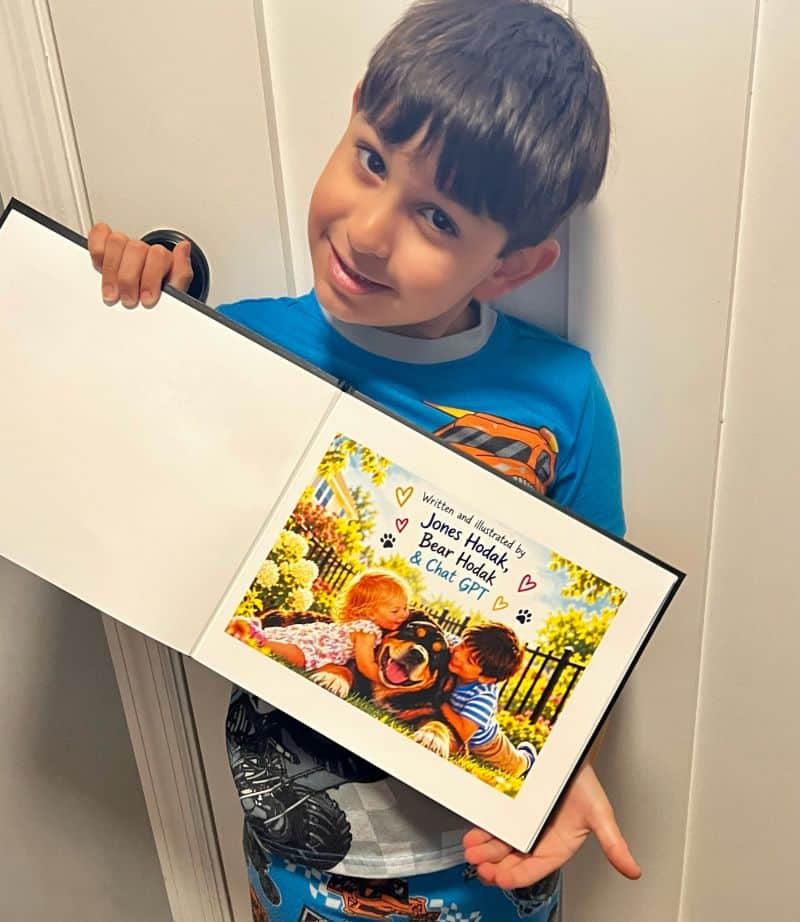
Over the weekend, my six-year-old son did something that would have seemed like actual magic when I was his age: He wrote, illustrated, designed, and produced a personalized children’s book for our neighbor’s second birthday.
And he did almost all of it himself.
Jones decided he wanted to make a book starring our dog, Bear, for our next-door neighbor, Rooney, who absolutely adores him. So, he opened ChatGPT and started talking.
He dictated the story, uploaded photos (after voice-texting Rooney’s mom to ask permission!), directed the illustrations, requested revisions, and kept going until everything looked exactly how he wanted. He even pushed back when ChatGPT tried to change the storyline.
I assumed the final step in the process would be printing out some images and stapling the pages together (that’s his normal method of “book-making”), but then I overheard him ask, “How do I turn this into a real book by tomorrow?”
ChatGPT answered that the Walgreens by our house could print it in about an hour. It sent a hyperlink to place the order and automatically resized all the images Jones had dictated.
Jones said, “Okay, Mom! I think I need a credit card now.”
Next year he’ll probably have an agent upload it, but I was thrilled to get the assist this time around. I was laughing at the party the next day when I heard him tell Rooney’s grandmother, “I did this 85% by myself, and my mom helped a little with the rest.”
Here’s what I think is the coolest part: Jones has absolutely no idea how hard any of this used to be.
He doesn’t know that creating a personalized, illustrated children’s book once required a whole collection of specialized skills, expensive tools, and significant time. Heck, it required all of those things in his lifetime!
He had an idea. He found a way to execute it. And when something wasn’t quite right, he simply asked for it to be changed.
To him, that’s normal. After all, the kid has been bossing Alexa around since he could talk. (I wrote once before about him “firing” Alexa when he was four, because she “wasn’t good for anything except telling me the time or the weather.”)
Watching him made me think back to when my family got our first computer. Microsoft Paint seemed magical! And then, a few months later, Prodigy (and later AOL) connected me to people, ideas, and information I could’ve only dreamed of before.
I wonder if my dad had as much fun watching his elementary-school-aged daughter discover the internet as I’ve had watching my kids discover AI.
Back then, I had no idea I was living through a technological revolution that would change humanity forever. I was just a kid having fun and being creative.
I was casually doing things that would have seemed impossible to my dad when he was my age.
Now, I’m the parent watching my own child play in a sandbox that would have blown my mind.
What feels like magic to one generation is just an everyday tool to the next.
How AI Is Changing Customer Expectations
As technology evolves, customer expectations evolve right alongside it.
And AI is accelerating that shift in ways businesses can’t afford to ignore.
If you serve customers, lead employees, or run a business, pay attention beyond “Cute story about your kid,” because there are three enormous customer experience lessons hiding in this story.
1. Today’s Magical Experiences Become Tomorrow’s Customer Expectations
Think about the experiences that blew your mind a decade ago: Real-time package (and pizza!) tracking. Same-day delivery. Instant answers to complicated questions.
Now think about how frustrated you get when those things don’t work.
Every remarkable experience resets our expectations for the next one, and AI is accelerating that process in ways we’re only beginning to understand.
My son won’t grow up thinking it’s impressive when a company can personalize something for him, respond immediately, or simplify a complicated process.
He’s going to wonder why every company can’t—or, more likely, won’t.
And increasingly, so will the rest of us.
Because customers don’t just compare companies to their competitors; they compare them to what they know is possible.
This is one of the biggest ways AI is changing customer expectations. As people experience faster, easier, and more personalized interactions in one area of their lives, they begin expecting those same capabilities everywhere else.
The bar for a remarkable customer experience keeps getting higher.
2. AI Is Changing What’s Possible for Businesses
“We’ve always done it this way” is becoming a very expensive sentence.
Maybe it’s because Jones knows I’m an author, or maybe it’s because he’s six, but he never stopped to ask, “Can I make this happen?”
He just started creating.
What would it look like to apply that same mindset to your work every day?
What if you could build the resource your customers keep asking for?
What if you could simplify the process that frustrates your employees?
What if you could create a personalized follow-up, prototype a new service, or solve a recurring problem without waiting six months for someone else to do it?
Of course, not everything can or should go to AI. Privacy, accuracy, judgment, and human oversight matter enormously.
But the number of things we can now try without a massive time or money investment is extraordinary.
In fact, I’m building an AI-powered tool right now that lets a client’s employees practice realistic customer calls in a judgment-free environment.
After each conversation, they receive feedback across five disciplines, including accuracy and empathy.
Employees can now practice conversations on demand that once would have required a trainer and/or a role-play partner.
AI isn’t just changing what customers expect. It’s expanding what businesses can realistically deliver.
Maybe the most important question isn’t “Can we do that?” but “Why haven’t we tried yet?”
3. Human Connection Still Matters Most in Customer Experience
Here’s the part of Jones’s story that matters most to me:
The technology isn’t what made the gift special.
Jones didn’t set out to create something with AI. He set out to create something for Rooney.
He knows she loves Bear, and he knew she’d love seeing herself in an illustrated storybook.
AI made that possible, but AI didn’t have the idea.
It couldn’t have, because it doesn’t know Rooney.
As technology makes it easier and cheaper to create things, the real differentiator won’t be what you can make, or even how fast you can make it.
It’ll be how well you understand what someone actually wants.
That’s true whether you’re serving a paying customer, supporting a colleague, or leading a team.
The opportunity to use AI in customer experience isn’t simply to do the same things faster. It’s to do things that make people feel seen, understood, and valued in ways that weren’t practical (or even possible!) before.
Personalization is becoming easier to deliver at scale. But meaningful personalization still requires understanding the human being on the receiving end.
The same technology that’s making customers harder to impress is giving us unprecedented opportunities to impress them.
To quote someone whose AOL fan chat rooms I definitely visited… Isn’t it ironic, don’t ya think?
What Businesses Should Do as Customer Expectations Evolve
The bar is getting higher, but so, too, is our ability to clear it. And when it comes to AI and customer expectations, I think that’s an incredibly exciting opportunity for businesses willing to rethink what’s possible.
As AI continues to reshape customer expectations, businesses have an opportunity to rethink what’s possible across the entire customer journey.
That doesn’t mean using technology for technology’s sake. It means identifying the moments where a better experience could make a meaningful difference—and exploring whether the barriers that once stood in the way still exist.
So here’s my challenge for you this week:
Think of one thing that would make someone’s experience better that you’ve dismissed as too hard, too expensive, or too time-consuming.
Then ask yourself: Is that still true?
You might be surprised by what you can create.
And you might just make someone’s day in the process.
Paragraph