


Episode Summary
How hard are your customers working just to do business with you?
In this solo episode, Brittany introduces the ACHE framework, a simple way to spot unnecessary friction in your customer experience. Where are customers having to Ask, Chase, Hesitate, or Explain again? Each one is a clue that something could be easier, clearer, or better designed.
And these friction points don’t just create frustration for customers—they create more work for your team, too.
In this episode, you’ll learn:
- How to use the ACHE framework to uncover hidden friction
- Why repeated questions can signal an experience design problem
- How proactive communication keeps customers from chasing you for answers
- Why hesitation is one of the most invisible forms of customer friction
- The two questions leaders should ask their customer-facing teams during Customer Service Week
- Why the people closest to your customers are often closest to your biggest opportunities
Whether you have a dedicated customer service team or you are the customer service team, Brittany’s challenge is simple: find one ACHE in your customer experience and fix it.
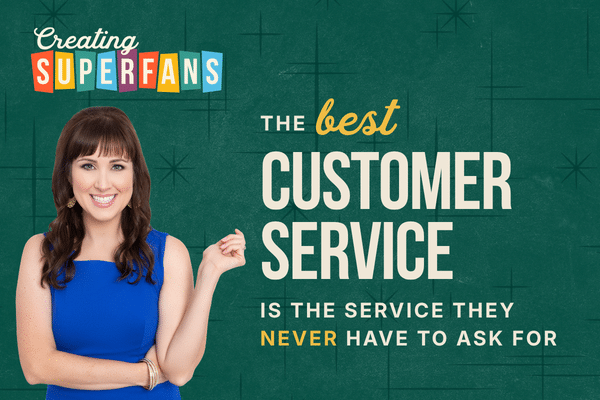
Because sometimes the best customer service is the service your customer never has to ask for.
Catch up on the SUPER AMAZING Show here
Listen to the Episode
Listen on Apple Podcasts
Listen on Spotify
Transcription
[00:00:00]
Brittany Hodak: I know it seems like there’s a holiday for everything, but hear me out. The first week of October is Customer Service Week. It’s been celebrated all the way going back to 1992, and it’s really about loving on the people who make excellent customer service possible. So the front lines of the team who is interfacing with your customers all day, every day.
And one of the things I always like to say is everyone is in the experience department. But this is the week that’s dedicated to celebrating those people who do have service or experience or something like that in their titles.
Now, when I say celebrate, I’m not just talking about buying them cupcakes or catering in lunch or writing them notes or giving them swag. Don’t just celebrate the people that are serving your customers.
Learn from them because that’s how everybody wins. And if you’re thinking, “Well, I don’t even have a customer service team, so this must not be a relevant episode,” ahaha, my friends. [00:01:00] If you do not have a customer service team, guess what? That means you are the customer service team, because customer service isn’t a department.
It’s everything you do to make it easier for anyone to be your customer, whether they’re a first-time customer, a long-term customer, or a former customer that you’re trying to win back. And sometimes the very best customer service is the service that the customer never has to ask for. So in the episode this week, I am going to give you a brand-new four-part framework that you can use to help make things easier for every single customer you serve.
And then for those of you who do have customer service teams or customer experience teams, I’m gonna give you the two questions that I want you to ask them this week as you celebrate them. Let’s dive in. , Here’s the acronym that I promised you.
Look at the ACHE in your customer experience. Ask yourself, where are customers having to ask, chase, hesitate, or explain again? And if [00:02:00] you find those ACHEs, those will give you the clues where something could be easier or better or designed a little bit differently, whether you have one person on your team or 100,000 people on your team.
Let’s start with the A, ask. What are customers asking that they shouldn’t have to? If you hear a question one time from one person, answer it. But if you hear the same question a bunch of times from different people, that tells me it’s an experience design problem. Maybe you haven’t been as clear as you should have.
Maybe you haven’t spelled out all of the steps, or maybe something just doesn’t make sense. But you wanna ask yourself, where are people asking questions? Because a repeated question is a clue that you gotta do something different. So ask yourself, “Is this something that three or more people have asked me lately?”
And if it is, look for ways to either answer it more proactively, so maybe that’s you make a quick video about it, you put it in an email, you send them to a part of your website where you’ve got the FAQs, or find [00:03:00] another way to get that information to them.
And if you’ve got somebody on your team who celebrates the fact that they know all the answers, that they’re like, “Oh, I love when people ask because I know the answers,” take a look at that too, because you wanna ask, “Well, why are people having to ask?” Sometimes we wear it like a badge of honor, like, “Oh, I know all the answers.
I know all the things.” But again, the best thing that you can do for your customer experience and your customer service is make that customer not need the service in the first place. So that’s your A in ACHE, ask. The C, one of my favorites, is chase. Where are customers having to chase you for an update, for an answer, for feedback, for news about what they’re expecting to hear or what’s gonna happen next?
Anytime your customer is chasing something down, it’s going to lead to uncertainty, and that uncertainty can lead to anxiety. Was this the right choice? Did I choose the right partner? Should I look for somebody else next time?
You don’t wanna give them the opportunity to have [00:04:00] those thoughts. So anywhere something is being chased, anywhere somebody is waiting for a long time for an answer, remind yourself, no news is still news. Like, if you are in the process of a long, drawn-out, multi-step thing, whether that’s getting information for your customer or finding an answer or whatever it is, remember, you can always send an email checking in, letting them know that you haven’t forgotten, you just don’t have an update, and you’ll update them again on Tuesday or Friday or whatever the case is.
So ask yourself, where in my experience is a customer likely to wonder, “What’s going on here?” Or, “What happens next?” Or, “What do I do?” If it’s something that they’re chasing, that’s an opportunity to relieve one of those ACHEes in your customer experience, because we never wanna make customers chase us for reassurance.
The H in ACHEE stands for hesitate. Now, this one is the sneaky one, because oftentimes hesitation [00:05:00] is invisible. So I want you to ask yourself, where might a customer be thinking, “Wait, what do I do next? What happens here?” At least with chase, they’re reACHEing out to us, so we see that one. But the hesitation is the one that sometimes is invisible if you’re not paying attention.
They might be wondering, “What option do I choose here?” Or, “What does this thing mean?” Or, “Okay, these three things have happened. What happens next?” And so often you don’t hear about that. I talk all the time about how customers that are not satisfied are more likely to go away without telling you than to tell you why they’re going away, because it’s so easy to just bounce.
People quietly lose confidence. They have questions that aren’t answered, and so that’s why this particular friction is so incredibly dangerous. So I want you to ask yourself, where is your customer hesitating? Go through your experience with fresh eyes. If you haven’t called your phone number, if you haven’t gone through [00:06:00] your online sales process, if you haven’t done all of the things…
You know what I recently realized on my own website? So I talk about customer experience, like, all day, every day, and I was testing a form, and I filled out the form, and there wasn’t, like, a thank you page at the end, and there wasn’t a pop-up message. And I know once upon a time there was, and it’s one of those things where, like, you update one part of your website, and something else happens, and then something else, and you change, and, like, you don’t realize over time something disappears.
And I was like, “How long has this been like this?” People are filling out this very important form on my website, the contact form, the form that’s like, “Hey, Brittany, we want you to come speak at an event.” And while I was getting that email from them, they weren’t getting a confirmation on the website that said, like, “Thanks for submitting some in- We’ll be with you right away,” or being redirected to another page.
Now, at one point, we had both of those things happening, and until I went to my website and filled out that form because I was testing a totally different thing, I had no idea it was broken.
Because what I do know is that I was getting the email, and they were actually also getting an [00:07:00] email saying, “Hey, thank you for your message. Somebody will get back to you right away.” Which is better than nothing, but they should still get something on their mobile device or their laptop letting them know that that form went through.
That’s a friction point that’s gonna make somebody hesitate or make them wonder what is going on. And those are the types of things that happen all the time that we just don’t see because we’re on the inside. Sam Walton, founder of Walmart, used to always say, “Walk an aisle in your customer’s shoes.”
Obviously, a play on the, you know, walk a mile, but walk an aisle in your customer’s shoes to see what they see, to understand what they understand. And this is a really good thing to do here because you can find out where they might be hesitating that would potentially be invisible to you if you were only looking at it from your side.
Finally, the E in ACHEE, where is your customer having to explain something again? Where are they repeating themselves? Where are they telling something they’ve told you already? Maybe it’s, you know, [00:08:00] they fill out an intake form, and then they have to answer all those same questions when they arrive at your office.
Or they’ve explained the problem to a chatbot, but now they’re transferred to a real person, and that person doesn’t see the chatbot history. Whatever it is, ask yourself, “Where are we making a double explanation happen?” Because what that really says, whether we want it to or not, is it tells the customer, “My time is more important than your time.
I am more important than you.” And obviously, it’s not intentionally what you’re thinking, but that’s how sometimes it comes across, right? Because again, your customers aren’t benchmarking the experience they have with you just against your direct competitors. They’re benchmarking it against the best experiences they have anywhere.
So every time they have an easy, effortless, friction-free experience, it primes them to be expecting that next time. Every great experience your customers have make them just a little bit easier to impress in the future.
So ask yourself, are there [00:09:00] places that your customers or clients are having to explain themselves again? Now, I know that sometimes there are legitimate legal or security reasons to verify information again, to have somebody repeat themselves. Fine, I get that. But make sure you’re, you’re explaining why.
Let them know why you’re doing it, because otherwise it just feels like we weren’t paying attention, or we don’t know you, or we don’t value your time. And remember, something else I say all the time, personalization starts with remembering. So there you go. Those are the ACHEes that you might be experiencing on the customer service side of your business.
Okay, here’s what’s interesting about all of these ACHEes. These ACHEes aren’t just things that suck for your customers, these are all actively creating more work for you and your team too. Because when a customer has to ask, guess what? Someone on your team has to answer. When they have to chase something down, somebody has to respond, or multiple somebodies have to respond over a period of time.
When a customer is hesitant, not only [00:10:00] is that bad for business if they’re leaving, but it also slows everything down. I’m actually in the middle of a process right now, uh, with a vendor where the way they ask me to upload something that’s really important for the first part of the project is just, like, really dumb and hard, and I keep not doing it.
Uh, my chief of staff has been out on maternity leave, and typically this is something that she would do, and I’m just like, “I have no capacity.” So I finally sent them an email and was like, “Hey, I’m not gonna do this. Like, full disclosure, this is not gonna happen. But could I just, like, share all of these Drive folders with you where all of this stuff exists?”
And they were like, “Yeah, sure, you can do that. That’s not how we normally do it, but you can.” So I let, I don’t know, six weeks, eight weeks go by, like some huge amount of time of me just continuing to not do this task because it was something that was gonna take, like, hours and hours and hours to do, and it had sort of been explained to me like, “There aren’t exceptions.
This is how we do it.” So all of that time, wasted, right? Slows everything down because I hesitated, because I was like, “I’m not gonna do this thing that seems like [00:11:00] it’s too hard, and I don’t understand why I have to do it this way.” So hesitation.
And then finally, E, explain again. Guess what? That is costing time too to multiple people on your team. People are repeating work that’s already been done, or they’re burning time. So this isn’t just about removing some things from your customer service to make things better for your customers, this is actively going to make things better for your team too. You’re removing meaningless friction so that there’s more room for meaningful human interaction, and things will be all around more delightful.
Now, if you do have a team, I wanna make sure that you are celebrating them for Customer Service Week. Obviously, you should be celebrating them all 52 weeks a year, but this is a really great one to make sure that they feel seen and known and appreciated.
My friends over at Sugar Wish are doing a lot of really fun stuff for Customer Service Week. If you haven’t already checked them out, you can listen to the episode I did with their co-founder, Elizabeth, earlier this season, and check out that episode for a special [00:12:00] promo code, I think it’s superfans, to save, I think it’s $10 on your first order.
So what are we doing to celebrate those people? Well, one thing that I want you to remember is that your customer service team isn’t a cost center, it’s actually a huge opportunity center, because guess what? These are the people that are closest to your customers, which means not only are they the front lines of your brand, but they also often have the very best insights.
That thing your executive team was gonna spend a lot of money on a research survey, uh, to uncover insights in a focus group, guess what? Your customer service people already know all of those things that you’re debating over of, like, what do we launch and what do we, what do we do next. Guess what? These are the people that might already have the answers.
That’s because they’re in it all day, every day. They hear the questions from the customers. They see their confusion, and they know what the customers hate and how to make their [00:13:00] lives easier instead of harder. So if you do have a team dealing with your customers, I want you to commit to asking people on that team two questions this week for Customer Service Week.
Number one, what’s the single thing you most wish leadership understood about our customers?
You’re gonna get such insightful answers from this. Leave it intentionally open-ended. One thing, that’s the sort of close-ended part, is we wanna know what your most… what you most wish we knew. But then leave it open-ended, just saying, “Understood about our customers”, because they might tell you things about how the customers use the product, about how prospects are, you know, checking out your product and making decisions.
It could be based in financial things, emotional things, logistical things, warranty things. Keep it vague, and you are gonna get such great answers. And then the second question, which ties back a little bit to that first question, is what’s one thing that we as the leadership team could do to make it easier for [00:14:00] you to serve our customers?
What’s one thing we could do to make it easier for you to serve our customers? So that first question is gonna uncover some of the customer friction. Again, it’s sort of intentionally, um, open-ended enough to have them talk across any different, uh, version of what that question means to them. And then that second question, or that second part, is uncovering the employee friction.
They are gonna let you know what they need. I recently heard a story from a client, they thought that they were saving so much time for employees because they launched this, um, like, electronic chat tool, and they were creating automatic updates to have the employees respond. And somebody made a mistake internally to where if you didn’t respond, even at the end of the conversation, it sent a reminder.
It was like, “You’ve gotta follow up with this client. You’ve gotta follow up with this client. You’ve [00:15:00] gotta follow up with this client”, and then it would, like, dock them on their scores. It would say, you know, even if they had, like, an average four-minute response time, now it would say, “Your response time is four days”, because there was some open-ended…
You know, somebody said, “Thank you”, and you didn’t say, “You’re welcome” at the end of a conversation the week before. And so this person on their exit interview said, “The reason I am quitting is because it’s become so frustrating to try to have to deal with things like this, and because I had to reach out to our client and say, ‘Hey, you have to let me get the last word if you reach out in the chat, because otherwise it’s gonna count against me on my performance metrics.'”
Now, obviously that’s, like, a wild example, and what that executive said to the person in the exit interview is, “I really wish you had told us, because that’s obviously a mistake. That’s obviously something that we could turn off.” It goes back to that idea of walking a mile or an aisle in your customer’s shoes and understanding what they’re seeing.
Um, the same is true for your employees as well. Because that employee friction, sometimes the [00:16:00] reas- The reason that employees don’t mention it is because nobody asked them, and they think, “Well, you’re making the decisions and dictating them to me, so I’m just gonna do what I’m told. I’m just gonna follow the rules.”
Or maybe they, in the past, brought up some sort of thing that is making their role harder, and people didn’t do anything about it, and they just assumed, like, you know, “My voice doesn’t, doesn’t matter, doesn’t count.” So ask them, “What’s one thing that would make it easier for you to serve our customers?” And then you absolutely have to act on that friction.
The cool thing is, that you’ll discover when you ask this question, oftentimes those two answers, the customer friction and the employee friction, are related. So if you fix one, you’re gonna greatly improve the other two. But always start with the internal, because your team is so critically important.
Always, always, always act on what they’re telling you. If they say, “This is the thing that we need to make it easier for us to serve our customers”, I promise you, you are gonna find a higher ROI on [00:17:00] that action than just about anything else in your business. So here’s my challenge to you for Customer Service Week.
If you are a solopreneur, I want you to look back at one month’s worth of emails, texts, DMs, calls, where- wherever your customer interactions happen, like, whatever your records are, I want you to look back at them, and I want you to look for the ACHEe. Where are your customers having to ask for something that, in a perfect world, they would not have to ask about?
Where are they having to chase something? Where are they hesitating? And where are they having to explain something again? You don’t have to totally redesign your entire customer journey. You don’t have to, you know, create a 47-page plan and say, “Here’s the, like, 1,800 steps that I’m gonna do.” Just fix one thing.
Choose one ACHEe and ask yourself, “How do I fix this?” Now, if you’ve got a team, you can certainly do that too, but asking those two questions is gonna help you get to these ACHEes [00:18:00] too. So your commitment is to ask those two questions. Remember, the first one, “What’s one thing that you wish leadership understood about our customers?
What’s that single thing you wish we understood and knew about our customers?” And then the second question, “What’s one thing that would make your job easier? What can we do to help you serve our customers better?” And then focus on fixing, fixing that. Now, of course, I hope that you celebrate your customer service team.
Buy the cupcakes, throw the party, do the pizza. But I promise you that the single best way to show your customer service employees that they’re valued and important isn’t to throw them a party. It isn’t to tell them thank you. It isn’t to tell them happy Customer Service Week. It’s to listen to them.
Now, if you need lots and lots of other ideas for Customer Service Week, I’m gonna direct you to my series of short videos with my dear friend Shep Hyken. It’s called The Super Amazing Show, and there are, at this point, over 150 different episodes [00:19:00] that he and I have recorded. Most of them are under two minutes and they’re designed to give you one great idea to act on, one fun thing to celebrate. You can find them on my LinkedIn channel and my YouTube page and all across social media, and they’re a really fun way to celebrate Customer Service Week. We will have an episode for every day of Customer Service Week.
Usually, the episodes come out on Monday, but because it is such a fun week, we will have five. I hope you tune in for all of them. And remember, this year for Customer Service Week, your mission, should you choose to accept it, is to find one ACHEe and fix it, whether you’re doing it alone because you’ve got a small team or whether you’re bringing in those all-important customer service teammates and asking them to help you identify that ACHEe.
Because sometimes the very best customer service is the service that your customer never has to ask for because you designed that friction away before they could find it. Thanks so much for listening. I’ll see you back here next week for another episode of the Creating [00:20:00] Superfans podcast.
Paragraph