


Episode Summary
AI is changing what’s possible—and raising the bar for what customers expect.
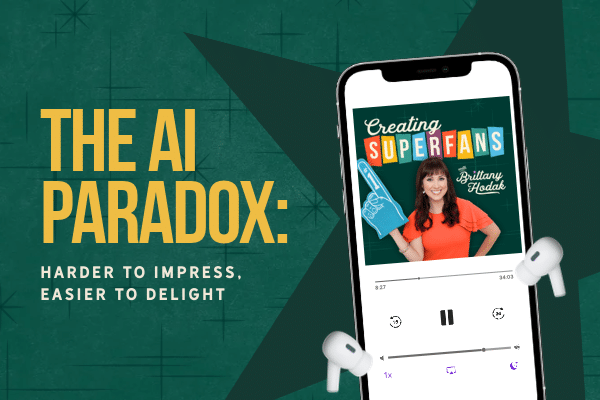
In this solo episode of the Creating Superfans Podcast, Brittany Hodak explores a fascinating paradox: The same technology that’s making customers harder to impress is also giving businesses unprecedented opportunities to exceed their expectations.
Inspired by watching her six-year-old son create an entire children’s book using AI, Brittany shares three important lessons for businesses navigating this rapidly changing landscape:
- Yesterday’s magic is tomorrow’s minimum expectation. Customers aren’t just comparing you to your competitors. They’re bringing expectations from the best experiences they’ve had anywhere.
- Stop defining what’s possible by yesterday’s limitations. AI is making it faster, easier, and more affordable than ever to experiment, innovate, and solve problems in entirely new ways.
- Human understanding is your greatest differentiator. When everyone has access to the same powerful tools, creativity, empathy, and thoughtfulness become even more valuable.
Brittany challenges listeners to carve out just 15 minutes today to experiment with AI, question what they’ve assumed is impossible, and explore new ways to make their customers’ experiences meaningfully better.
Listen to the Episode
Listen on Apple Podcasts
Listen on Spotify
Transcription
Brittany Hodak: [00:00:00] My six-year-old just blew my mind. He decided on his own that he was going to create a children’s book for our neighbor’s second birthday. I assumed he was gonna grab some construction paper and crayons, but instead he said, “Give me your phone. I wanna use ChatGPT.” And over the next hour, he came up with an idea for, wrote copy for, gave instructions for illustrations for a really solid, awesome book about our next-door neighbor and how much she loves our dog, Bear.
Then he did something that was the craziest thing of all. He said, “Chat, how do I make this a real book?” And without missing a beat, ChatGPT said, “You can print it at Walgreens down the street. They’ll be able to do an 8.5 by 11 version that’s 20 pages or more, and it’ll be done in an hour.” And I heard him say, “So do I need my mom’s credit card, or what do we do now?”
And the wildest part of all of this wasn’t what he [00:01:00] created, wasn’t even the intentionality and sweetness behind this idea of, like, wanting to create this thing that he knew our neighbor would love. It was that he had absolutely no idea how wild this is. So what happens when an entire generation grows up believing that if they can imagine something, they should just be able to create it instantly?
I think this is wild, and I think if you are not on top of the expectations of your customers and the next generation of customers, then you are in a world of trouble. So that’s what we’re gonna be talking about today, is the fact that every single generation inherits- What were miracles to their parents as the starting point, and AI is accelerating this for sure.
It’s simultaneously raising customer experiences and giving businesses unprecedented [00:02:00] opportunities to exceed those same experiences. That’s the paradox, right? The, the expectations have never been higher, but we’ve never had more cool tools at our exposure to do these really awesome things for our customers.
So I, I’ve been thinking a lot about this. Um, just to take it back a step, my kids have a lot of access to technology. I know every parent sort of comes at this different. I think it is so cool to watch what my kids do and dream up, and the ability that they have to use technology to create things that they are imaginate- imagining.
I know some people say technology makes kids less creative. I know for a fact that if you are using technology in the right way, it can make kids more creative, because I’m watching that unfold in real time with my kids. And I think the same is true of your, your team, your employees. Like, if they’re using technology in the right way, not to outsource the thinking part of their role, but to say, “How can I be more innovative, more creative, more cool?”
You’re gonna have some [00:03:00] really amazing outcomes. Now, the thing that was really fun for me watching my six-year-old just, you know, dictate to this technology the book that he wanted, and it was so cute. He… So he wanted the story to be about how Rooney, our little neighbor next door, is best friends with Bear and all the fun adventures they go on.
And most of these adventures he’s, like, imagining, because she’s still little and our dog is really big. Um, but it was just, like, so sweet and cute. And every now and then chat would take it too far. Like at one point I heard him yelling, “Why did you make me kiss Rooney? I would never kiss her,” because it was an illustration of Jones, like, kissing her on the cheek.
And he was like, “Delete that right now. Don’t let anybody see that.” Um, and, you know, again, so many lessons there. The fact that one of the things that I say sometimes is high tech plus high touch create high impact, and the high tech powered what he did, like it was the backbone, but it was his [00:04:00] creativity and intentionality and knowing what he wanted that brought that whole project to life.
And as I was watching this, I was thinking about how cool it is as a parent to see your kid do that, and I thought about when I got my first home computer, because I wasn’t that much older than Jones. I was probably, I don’t know, eight or nine, and very quickly thereafter, my dad bought the, like, expansion to be able to have the internet.
We had to buy, like, the CD-ROM drive to be able to, like, put the, I think it was like a Prodigy CD in to be able to get the dial-up internet. And very quickly, you know, like every kid with technology, I was, I was doing new things. I was, I was Increasing the size of my world and the, the worldview that I had of what was possible, what I could create, what I could do.
And I bet it was so cool for my dad to watch me do that because again, to me, it was just like, oh, we have this cool new thing. Um, but watching Jones and my older [00:05:00] son Cato, who’s nine, use AI makes me wonder, like, what are their kids gonna be able to do? And the fact that every generation sort of inherits, as I said, what was a miracle to their parents as just sort of the starting point.
My kids have this book. It’s called Moon’s First Friends, and the book is written from the point of view of the moon and how the moon has been watching Earth forever, the animals, the people, and all the moon wanted was for somebody to come visit her. And it goes through all of the, you know, phases of history and flight and then air travel and how happy she was when Neil and Buzz came to land and, and then the, the missions past that, the, the five more moon missions.
And, um, anyway, it’s like such a fun, cute story for kids. But when we read it, I always think about the fact that for millennia, like probably since human history began [00:06:00] All people thought about, not all people thought about, but, like, everyone probably imagined what would it be like to fly. What if I could fly?
What if I could fly? What if I had wings? What if I could be in the sky? What if I could do that? And then, you know, as transportation progresses, like, what if I could get from point A to point B faster? What if it didn’t take weeks and weeks and weeks to cross the ocean on a ship? Just, like, all of these things.
And then in the span of a couple of generations, not only is that possible, but now it’s so routine. Like, I take over 100 flights a year, and I think about the fact that for, like, literally centuries and probably millennia, my ancestors would’ve not been able to believe the fact that air travel was a thing.
And now I’m like, “Ugh, the gate changed,” or like, “There’s no Wi-Fi on the flight,” or, “I’m not in the best boarding group.” Just, like, the things that to us are inconvenient or annoying because our expectations are so high. So there’s a few lessons in this [00:07:00] episode. Here’s the first one that I want you to write down.
Yesterday’s magic is tomorrow’s minimum expectation. Your customer expectations do not reset just because they’re jumping from, like, a different industry to your industry. They are take– bringing along with them the expectations they have of the best experiences they’ve ever had. And when any part of their life gets easier, gets more effortless, gets more frictionless, guess what?
Like, that is now the expectation they have. They want package tracking and delivery that’s as fast as Amazon. They want to be able to see exactly where something is the same way that they can see it in Uber or Instacart. They want you to know them at the level that Netflix and Spotify know them. They want AI to be conversational and intuitive with highly customized outputs.
Like, that is the bar, and meeting that bar isn’t something that you get to high-five about. It’s like that’s literally the bare minimum, what you’ve [00:08:00] got to do. So I want you to think about that when you think about how you’re using AI right now and how you can use AI to make things easier, better, more frictionless for your customers.
Because again, they’re not just benchmarking you against your industry or your direct competitors. They are benchmarking you against what is possible. So you’ve gotta think about that gap of, like, what do they want? Where are we at? And how do I close that as fast as possible? Because that’s the opportunity, and that’s also the assignment.
So the second lesson that I want you to take away from this story is that it’s time to stop asking what was possible
So here’s a question that you can ask. What’s something that feels normal in your personal life, like as a consumer, that still feels unnecessarily complicated or complex in your professional life? And is there a gap that you can close using [00:09:00] technology that exists? So for instance, if something is really easy in one area, but you feel like maybe it’s difficult for your customers or your consumers, what’s something that you can do?
Is there complexity that you can figure out how to simplify? Is there friction that you can figure out how to remove? All right. Lesson number two, I want you to stop asking what’s possible based on yesterday’s limitations. AI is changing the economics of experimentation, like literally every day. Things that once required entire departments, weeks, months of efforts, tons of money, specialized skills, now can be prototyped like right now.
So I want you to think more like a six-year-old playing than somebody who’s, you know, bringing 30 years of experience and thinking about how things were a couple of LLM models ago, or like a few years ago. Jones didn’t ask whether or not he needed to learn a new skill or install a new tool or hire a professional.
[00:10:00] He said, “I’m gonna create a children’s book,” and he figured out a way to do that. So I want you to think practically about like, what do you need? One fun example that I’ve been working on this week, I’ve got a workshop coming up where I’m working with a lot of professionals, and the gap that their leaders identified on a pre-event call was sometimes they’re hesitant to talk on the phone.
These are younger professionals who may be conflict averse, may rather, like, explain something in email. And so working with ChatGPT, I built a really cool tool where they can have model conversations. Um, and it works just like a phone call, and you can use voice AI to work through these simulated client complaints.
And you choose the type of complaint you want or if you wanna be surprised, the complexity of that complaint, and then you have this role-playing phone call. And then at the end, there’s a scorecard that I developed that ranks you from one to five across five different categories. Now, this was [00:11:00] really fun to build and deploy, and I was really inspired by Jones.
I was like, “Okay, what do I wanna create?” And I started with the end in mind. So start with the end in mind, and don’t ask yourself, like, “How would I have done this three years ago?” Or, you know, “How have we always done this?” Like, those are some of the most expensive words anybody can ever say is, like, “We’ve always done it this way.”
But start with the end in mind, and then reverse engineer what you need. So if you’re a solopreneur, maybe you need a new client FAQ. Maybe you need a really cool, thoughtful follow-up resource. Maybe you need a personalized onboarding guide. Like, what can you create? If you’re a manager, maybe you need more training tools.
Maybe you need, again, help, like, role-playing a difficult conversation. Maybe you can create something for your team for them to walk through, um, the things that, that come up in their role. If you’re an executive, maybe you wanna build a digital AI version of your board of directors that you can go to and get, you know, pretty accurate, um, models [00:12:00] of how is this presentation gonna go over?
What is gonna happen when we share this idea? Like, there are so many things that you can do. The gap between experimentation and deployment has never been smaller, and that is gonna continue to close. Now, I obviously have to say here that you have to be thinking about things like privacy and accuracy and the appropriateness of the content that you create and accessibility.
So I’m not saying speed for speed’s sake. I’m just saying you can prototype something faster than ever before and have so much fun getting to a place that you can make things that are, like, really neat and cool. Um, all right, next lesson. In a world where it is getting faster and faster for anybody to be able to create Your competitive advantage becomes the insights and the knowledge and the understanding and the empathy that goes along with that creation.
Technology can make remarkable experiences pretty [00:13:00] accessible, but the ability to understand what would be meaningful to someone is the essential part. That’s the hard part. Again, with Rooney’s book, Jones could have said to AI, like, “Hey, make a book for my neighbor,” and it would not have been able to create because it did not have the same inputs of him talking about how much Rooney loves Bear, how much he loves hanging out with Rooney, uh, you know, put a pool in her backyard, put a trampoline in our backyard, like all of those things.
And for me, I always bring it back to what I talk about, which is the super model. Um, start with your story, understand their story, personalize, exceed expectations, and repeat. And these pillars matter even more in the age of AI than they ever have before because, you know, there’s a difference between personalization and thoughtfulness.
Personalization is like putting somebody’s name on something, whereas thoughtfulness is knowing what that person needs, like the right insight for the right person at the right time. And while [00:14:00] AI, yes, in some ways can help us in our ability to, to act on understanding. We still have to be the ones who develop it, right?
It’s not personalization for personalization’s sake. Um, the, one of the funny examples that I’ve been thinking about the past few days because, um, I’m recording this on Monday, November 2nd, right before the midterm elections, I’ve been getting this crazy text for, like, a week now every day that says, “Brittany L.,
we see you have voted in this midterm election, but your housemate, Jeffrey M., has not. Please remind him how important every vote is, and make sure he votes on Tuesday, November 3rd, election day.” Which is wild, right? Like, I would rather not get that creepy-ish text. He’s also getting a similar version of it that’s like, “Hey, you haven’t voted yet, but your housemate has, and we let them know you haven’t.”
Which, again, feels like a weird kind of peer pressure thing. Um, and don’t worry, he’s gonna vote tomorrow. He likes to [00:15:00] vote on voting day. Um, but I… Like, there’s a difference between personalization and the thoughtful, intentional human side of deploying things in a way that feel really great. So, um, I guess the question is, like, are you using AI to do more things or to do more things that actually matter?
And, um, I heard somebody say something the other day along the lines of, like, um, AI makes, uh, mediocre teams, like, faster at doing mediocre things. So being really intentional about what you’re doing because, you know, as I said before, there’s sort of this paradox of, like, the technology that is making customers harder to impress is also giving you unprecedented opportunities to impress them, right?
So what you’ve really gotta lean into is understanding, like, as much as AI makes speed and convenience and personalization easier to deliver, [00:16:00] those things are now less of a differentiator. Um, the bar is higher It’s harder to clear the bar. I, I think sometimes about, like, at some point in history, there must’ve been, like, a first Mexican restaurant to give out chips and salsa.
There must’ve been, like, a first Chinese restaurant to, to hand out fortune cookies. And those things, I imagine, were probably differentiators until they weren’t anymore. And probably, like, the actual factual reality is that it wasn’t, like, a single place. It was probably, you know, several places simultaneously.
Who knows? I don’t know. I haven’t looked that up. You don’t have to fact-check me. But, like, um, just know that once everyone has access to the similar tools, the similar ideas, the differentiator becomes the quality of the questions that we ask, the problems that we choose to solve, the care that we put into the experience, what we are designing for people.
So just remember, AI, if you think about it as, like, raising the floor of what’s possible, the [00:17:00] human touch is what’s helping us raise the ceiling. Like, how are you showing that you understand it, that you can connect your story to theirs? So as we close things out, I wanna bring this back to one concrete challenge, and that’s carve out 15 minutes today and just play with AI.
Ask yourself, like, “What would make the experience that my clients have with me meaningfully better?” Maybe there’s something that you’re assuming is impossible simply because, like, it would’ve been impossible six months ago or 12 months ago. Um, but is there a better way to approach it? Is there something you can build?
Is there something you can demo? Is there something that you can test? I think one day, decades from now, Jones is probably gonna be watching his own kids doing something that was, like, completely impossible right now, and maybe he’ll be really impressed by that. And maybe the thing that will [00:18:00] impress him the most is the fact that his kids aren’t impressed at all because to them it’s just normal.
Every generation inherits the previous generation’s miracles as their starting point. The question for us isn’t whether or not expectations will keep rising. They absolutely will all the time. The question is whether we’ll keep expanding our idea of what’s possible right alongside them. And maybe, just maybe, the best way to create more superfans is to approach our world with a little bit more of the curiosity, imagination, and determination of a six-year-old who wants to make a gift for his friend.
Thanks so much for tuning in. I’ll see you again next time for another episode of the Creating Superfans Podcast.
Paragraph