



Every election season, I’m reminded of two things: Political advertising can get really weird, and people will go to extraordinary lengths to support something they believe in.
And believe it or not, there’s a valuable lesson here for businesses wondering how to turn customers into advocates who are just as passionate about spreading the word.
Let’s start with the weird part.
During a recent election, I received the same text message every day for a week. It informed me that public records showed I’d already voted, but my husband hadn’t.
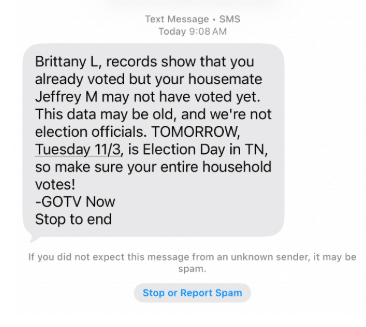
Yep, that’s a real text telling me that records show I’ve already voted, but my husband hasn’t.
He was planning to vote on Election Day. He likes to vote on Election Day. My policy is I’ll vote any day they’re handing out stickers, but to each their own. 🙂
Can we talk for a second about how weird and creepy that text is, even by “yeah, duh, politics in the US is always super weird” standards?!
Personalization should make people feel seen, understood, and valued. Not watched, tracked, and icked out by your message.
Just because you CAN personalize something doesn’t mean you SHOULD.
But beyond the questionable marketing tactics, there’s something about election season that I find particularly fascinating. And it offers a valuable lesson for any business wondering how to turn customers into advocates.
What Political Superfans Can Teach Us About Customer Advocacy
Every election season, someone inevitably asks me what I think about political superfans. And while there’s a LOT we could unpack about the psychology of political fandom, there’s one thing I find particularly fascinating.
Think about the lengths people will go to for a candidate they believe in. They’ll spend their weekends knocking on strangers’ doors, making phone calls, donating their hard-earned money, putting signs in their yards, and having conversations with friends and family members about why their candidate deserves support.
In other words, they voluntarily do exactly what most businesses spend millions of dollars trying to get their customers to do.
And that raises a question every business leader should be asking:
What makes someone worth campaigning for?
How to Turn Customers Into Advocates (Instead of Just Advertising to Them)
So many companies spend an enormous amount of time, energy, and money trying to convince people that they are great.
They run ads, send emails, create social content, invest in technology, and come up with increasingly sophisticated ways to get their messages in front of the right people. (Including, apparently, texting their spouses about their voting habits. 🙄)
But here’s something I wish more companies would consider:
What if we spent as much time giving people reasons to talk about us as we spend trying to get their attention?
Think about the last time you enthusiastically recommended a business to someone. Maybe it was a restaurant, a hotel, a service provider, or a product you absolutely love.
Nobody paid you to make that recommendation. You didn’t get a commission or a campaign button. You shared it because you genuinely believed someone else would benefit from the experience you’d had.
That’s the kind of organic customer advocacy every business should aspire to earn.
But a quick (nuanced) warning: Political campaigns can generate tremendous enthusiasm by giving people something to rally against. I don’t think that’s a particularly sustainable strategy for businesses.
Have you ever sat through a sales pitch where a company spent more time criticizing its competitors than explaining why you should choose them? 🚩🚩🚩
Convincing someone you’re the lesser of two evils might earn you a sale today, but what happens when the competition improves? What’s keeping that customer loyal to you?
There’s a big difference between giving people something to rally against and giving them something worth rallying around.
The latter requires more than clever marketing. It requires consistently delivering experiences that make people feel seen, valued, and understood. It means giving customers stories they can’t wait to share, and reasons to feel proud of their decision to do business with you.
And the best part? Those stories travel farther than your marketing budget ever could.
It’s why I say, “When you tell the world you’re great, that’s marketing. When your customers tell their friends you’re great, that’s magic.”
3 Ways to Inspire More Customer Advocacy
So, how do you turn customers into advocates who genuinely want to spread the word about your business?
Here are three places to start:
1. Give customers something worth talking about.
People rarely tell their friends about an experience that was exactly what they expected. Look for opportunities to exceed expectations, solve a frustrating problem, or add a thoughtful personal touch. Sometimes, the smallest moments create the most memorable stories.
2. Make customers feel like they belong.
The strongest customer relationships go beyond transactions. When people feel connected to your brand, understand what you stand for, and see themselves reflected in your story, they have a reason to stick around. And, more importantly, a reason to invite others to join them.
3. Make exceptional experiences repeatable.
One amazing interaction might earn a glowing review. But consistently delivering on your promises is what builds lasting trust and loyalty. Identify the moments your customers love most, then create the systems, processes, and habits that make those moments happen again and again.
None of these strategies requires a massive marketing budget. But they do require intentionality.
Of course, I’m not suggesting you stop advertising or marketing your business. But I am suggesting that the experiences you create deserve at least as much attention as the campaigns you run to promote them.
Would Your Customers Recommend You Without Being Asked?
I want to leave you with a question:
If your company stopped advertising tomorrow, would your customers pick up where you left off?
Would they tell their friends about you? Recommend you without being asked? Go out of their way to convince someone else that you’re worth choosing?
The goal isn’t just to win someone’s business. It’s to earn the kind of enthusiasm that makes them want to help you win someone else’s.
The best campaigns aren’t the ones you run… they’re the ones your superfans run for you!
Paragraph